

Borrowing someone's towel is as human as it gets,
Each other's basic recognition that sleeping wet is simply no fun,
Not to mention getting your clothes wet.
A premonition between the two that an intimacy will be shared.
The Human Towel exchange is a magical thing,
Sparsely shared,
Especially now-a-days.
When I'm older I want my towel handovers to be fun.
A nice moment shared when grabbing a 1998 Wimbledon towel from the other person,
A simple chuckle as they read the year on the frilly textile,
Before rubbing it all over their naked bodies like the bar of soap before it.
Share more towels,
If you can
Although not too many
As there are nasty things floating about.
All posts by hamishcraig
Weekend Finds + Favourites: 07/10/23
The following are just a few tracks and images that I recently came across. I hope you enjoy them as much as I do.
This one I found from a “Moog Board” playlist on Spotify. It gets quite cinematic towards the middle, something I can definitely imagine myself using later on in life if I ever get round to creating a montage of happy memories. Until then it can just remain a fun track.
This one’s a little more on the nose but delivers that feeling of being on the Brazilian coastline. No doubt a classic over there and one I hope to encounter while sipping my morning coffee at my future favourite spot.
Stumbling across this light jazz number towards the end of listening session, a favourite from the Japanese Jazz playlist I had great fun delving into.


Nike Fuelband, patent leather Air Force 1s and two Yeezy’s off of Virgil’s old blog, an era dripping in nostalgia. One day I hope to drop a Bobbito-style book with my life’s take on footwear but for now, a small dump on the website will have to do.

September Poetry: Dishwasher
I was
in that moment,
	more conscious of being alone.
No one to
	share a to-and-fro with,
merely a gentle breeze
	as my companion,
one that ad been there for
	quite some time,
	walking hand-in-hand
consoling many a sole
that spent its time on earth
as one.
	This was and is a
moment that people will share
when letting others into
their home.
	Happy to have guests
	but less inclined to enjoy
	washing the dishes after
they’ve left.
Although that’s what dishwashers are
for.

June Poetry: Words On York
The history was palatable,
From the grass tucked between the cobbled streets,
to the cold faces of men
scribed onto the Minister walls.
It wasn't the first time that men managed to clamber onto
history through the labour
of other men.
The toil of forgotten souls who
spent days carving cold stone,
only for those inside to look
to the sky in search of theirs.

     Friendly voices would echo against the cavernous walls of the Minister,
thousands of hours etched into sounds that would leap out onto the ears of eager-minded travellers.
     "The word for apple is also the word for fruit in Latin",
beckoned one of the more lively tour guides,
another simple mistake that had managed to perch itself within culture for centuries.
Decades of musical references at once dispelled by a tentative historian,
his only hope be that more people spread the same message.
  Upon entering,
One of the Fathers would utter words
in a moment of prayer,
people would sit in silence,
returning to childhood experiences when
older people were the voice of reason,
all of whom were looking for one small
moment to let go of responsibilities
and forget the family sat next to them,
most of whom were dependent on their strength
and guidance.
    As the train drifted downwards,
the constraints would slowly fall back into position,
an unexplored city now less enigmatic,
a string of kind people
and good coffee
to thank.

June Poetry: Solace In Silence
The quiet times were always the loudest.
The grass would whisper,
the trees would coddle together,
preparing a surprise for the
humans' senses,
protecting the sun from
vengeful eyes
        with its patchy branches.
        Specks of light would
           rush through,
        a result of the trees position
       among the sea of tall grass.
       Both would bend to the wind,
days spent admiring the power
of a being that only
existed in passing,
reflecting on its fallen members
in a jovial compassion.
Neither the grass or the tree
would linger in its disposition.
    The sun would shine regardless.

Thoughts on – Notebook on Cities and Clothes (1989) by Wim Wenders
I was recently listening to the MUBI podcast when I came across an interesting name, Wim Wenders. Little did I know, I had saved his “Paris, Texas” (1984) on my MUBI watchlist. During the podcast, the interviewer referenced a documentary that Wenders had made on Yohji Yamamoto which I immediately made note of. I knew little of Yohji Yamamoto’s work bar his adidas sub-label, Y-3. Wanting to learn more about the fashion designer, I found his documentary available on YouTube (although you can watch it for free via Vimeo).
The documentary was unlike any other I’d seen before, with a small digital screen playing while Wenders would simultaneously travel whichever City he was in. Two scenes stood out to me; 1 – the scene in which Yohji is adding his signature to the store sign outside his first shop, and two – the part where he is flicking through a book full of images of people from what seems like the 40s. This quote also stood out to me:
“Form and material, same old dilemma, same ritual as any other craft. Stand back, look, approach again, grasp, feel, hesitate, then sudden activity and then another long pause. After a while I began to see a certain paradox in Yohji’s work, what he creates is necessarily ephemeral. Victim to the immediate and voracious consumption which is the rule of his game. After all, fashion is about here and now. It only deals with today, never yesterday. By the same token, Yohji was inspired by the photographs of another time and by the work clothes of an era when people lived by a different rhythm and when work had a different sense of dignity. So it seemed to me Yohji expressed himself in two languages simultaneously; he played two instruments at the same time. The fluid and the solid. The fleeting and the permanent. The fugitive and the stable.” – Wim Wenders narration [20:15-21:15].
The scene at around 105 minutes also echoes this idea, as Yohji is fascinated by the people captured in the book. The quote taps into many themes, such as authenticity and ever-increasing cycles of fashion, both of which are more relevant than ever today. Given the documentary was recorded and released in 1989, it acts as another reminder of the power of nostalgia. As part of the Zillenial tribe who laments the simpler childhood days of the ‘90s, I didn’t realise it was the same for every other generation who were stuck romancing the past.

The people in the photos were born in a time when people were more present. People played less of a character as their circle of inspiration was smaller, the world felt smaller. Labour and goods wasn’t as frequently exported so the clothes of people reflected the hands-on nature of their role. The digital world was yet to exist so reality was very much in the here and now, playing out right in front of you, therefore you had to be dressed accordingly.
Clothing and textiles were nation or even state/county-based, therefore quality and function were that much better. These were clothes that would be lived in for years, also had to put up with the climate and ongoing hardships. Yohji understands this much better than most. This intimate level of knowledge can be seen throughout the entirety of his work.

Yohji eloquently summarises this when flicking through the book, “Men Of The Twentieth Century” by August Sander, “I’m especially curious about their faces, because of their career, life, business. They have exactly the right faces for that I think. I’m admiring their faces and clothing. For example, when I look at people on the street in a modern city, sometimes I can’t understand which profession they join in, they all look the same for me. But in this time, people looked like their profession and their background, their faces are their name card. Their clothes are very representative of their business and lives, so firstly I look at their faces and then imagine their profession.”
For perhaps the first time in centuries,there exists a gap between our identity and our work. This gap has only gotten wider since the documentary first aired, with the likelihood of it only expanding further. I recommend giving the documentary a watch, which you can do so here.

Random Writings: The Big Red Balloon
The balloon was beginning to frustrate him. Its pull grew increasingly larger as the wind picked up. His coat had seen better days as well, drenched by the westerly showers that this particular region was known for. It had often protected him from the brash environment of the underground, not that it ever rained there. If it did, it would have truly been the most miserable place on earth, but luckily for him, British transport had the tendency of being waterproof. The balloon overhead wavered while he remained fixed in his position, eager to prove the naysayers wrong. He could feel the blood slowly start to fall away from his hand, the lack of dexterity pointed out by the marching of ants down one side of his arm. He’d always hated pin and needles, early childhood memories filled with the ongoing fear of sitting still for too long. Clinging onto this great red floating object in the sky had begun to become more than a physical nuisance.

Skepta Wearing the Oakley Factory Team Flesh
Back in February, Skepta was sent to Japan on a PR campaign to explore his relationship with PUMA. Sabukaru did a great piece on this titled “24 Hours in Tokyo with Sabukaru, Skepta and PUMA”. It’s definitely worth checking out as it gives you an interesting look behind the scenes. Apart from the trip being a marketing piece for the newly created Velophasis silhouette, the multi-hyphenated artist managed to visit the PUMA archive in Germany, where he no doubt kept an eye open for a silhouette for his next collab.

A few days later, Skepta took to JME’s BadmanOnline Twitch channel during a late-night studio session, proceeding to show off a pair of creps he’d picked up on his trip. “You lot seen these? Mad tings, make sure to take an extra suitcase cause they’ve got some serious stuff out there”, he said while showing off a pair of the Brain Dead x Oakley Factory Team Flesh in the “Iron Brown” colourway to the people on the stream.

Oakley has been trickling back into the functional wear scene as Instagram accounts such as @inside.tag put people on game. As the hype for Nike’s ACG division slowly moved into Arcteryx between 2019-2021, other authentic brands such as 66 Degrees North and Oakley are now the focus for people who are tuned into the scene. While Oakley is far from breaking out onto the mainstream stage, people with an actual interest in outdoor wear are happily gathering up all the early 2000s and ‘90s pieces knowing the brand’s existing reputation as authentic functional wear.
The Oakley Factory Team Flesh is an interesting silhouette to say the least, created in June of 2000 and like other footwear that was released at the time, was way ahead of the curve. The neoprene booty entry foregoes the need for laces, while the upper’s water-wicking abilities and Open-cell Aeroprene ensure your feet don’t get wet or sweaty. The most interesting component is definitely the sole unit, with its wavering midsole and Traction Pod system underfoot that enhanced “tactile awareness”. This was perhaps Oakley’s attempt to dip its toe into the world of minimal footwear, a field that adidas was exploring with its Feet You Wear range from the ‘90s and ACG’s experimental pieces that ex-Nike designer Steve McDonald previews on his Instagram account.
Surprisingly, the Factory Team Flesh doesn’t stand out like a sore thumb among Oakley’s back catalogue of footwear, with the brand often leaning into the theme of unconventional design. It’ll be interesting to find out who was the creative lead for Oakley during that era, especially as we see archival models make a comeback through collaborations with Brain Dead. As Skepta’s track record has proven time and time again, the artist has an eye for good taste, so let’s hope we get more tasty revivals from Oakley.
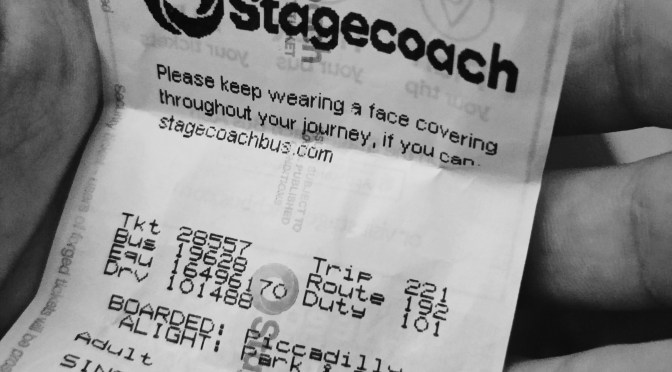
March Poetry: Last Bus Ride In Manchester
I found a ticket in my
coat pocket the other
day.
It was a bus ticket
from Manchester.
I’d paid cash.
"Piccadilly,
where dreams go to die".
Lots of things happen there
some good
some bad
all rad?
My bad
Hey dad …
I’ll stop now.
I don’t exactly miss that bus,
its shuddering presence,
the questionably warm back seats of the lower deck.
They'd always smell like a years-worth of engine fumes,
stored away into the
hard wearing abstract pattern.
That
or an ill-kept Henry Hoover,
which I suppose is a small price to pay for comfort,
especially when considering the chilly temperatures of Manchester's winter.
The bus ticket was probably one of
the last things I bought in that city.
Although I’ll no doubt buy more in future,
chugging up and down the surprisingly straight
Oxford Road,
with it's mixture of grandiose and less-than-grand architecture plotted along
somewhat randomly.
	Buses are an interesting place,
Reminds you how slow life can be
when you’re stuck in a traffic jam with
everyone.
All suspended in thought … well
not all, but most.
Some would rather shout about it,
announcing their thoughts out loud
hoping someone will join in,
which they seldom do
if they have any sense.
Let bygones be bygones.
and let people who shout on
buses do their thing.
Good rules to go by in life.
Here’s to the next bus journey I inevitably take in Manchester because of an unsurprisingly 'sudden' downpour.

I Wish (2011) – A Film Review
This film took me back to my childhood in a massive way. The carefree attitudes, the swimming lessons, discussing how the leftover crisp packet crumbs are the best bits. Luckily, that’s not all my childhood consisted of, had it been I’d probably be an Olympic-level swimmer with a Walkers deal … which upon reflection doesn’t sound all that bad.
I am currently making more of an effort to watch Japanese and South Korean cinema. To be honest, I’m trying to watch more films in general. My best year for Film was 2017 when I was in my second year of University. I’d often receive and be given recommendations from a friend at film school, discussing genre-bending pieces like Ben Wheatley’s A Field in England thanks to a recommendation from the king of film criticism, Mark Kermode.
Of course with Japanese and Korean cinema, the settings are based in places I know little of, which was part of the charm surrounding I Wish (2011),a film directed by Kore-eda Hirokazu. There was something tangible captured in its 128-minute runtime, I myself felt part of this group of friends, feeling somewhat exhausted after watching them traipse up the long and winding hill to school. My journey was slightly easier, consisting of an hour-long bus journey where the sweltering Indonesian weather was only made bearable by the occasional gust of wind from the bus window.
Swimming was an enjoyable part of twelve-year-old Koichi’s day, a subject he’d discuss over the phone with his brother Ryunosuke in great detail. The film was so brimming with a childhood innocence that even when Koichi’s friend revealed his recently dead pet dog was in his backpack, it was endearing and not completely horrifying. There’s obviously more context, yet it proves how focused Hirokazu’s direction was throughout the process, flipping this horror-esque trope on its head. I was totally invested in this journey, eager to watch these brothers reunite amidst the complications of their parent’s divorce.
As a backdrop, Japan plays a huge role in the film, with its many cultural colloquialisms seeping onto the screen. A huge volcano would linger in the background as Koichi would walk to school, its towering presence over Kagoshima a factor that the residents would simply have to put up with. One can only imagine how terrifying that would be as a child, a cultural separation that the director was tasked with communicating to the Western audience.
One of the mothers works behind a bar, serving drinks to elderly gentlemen while reflecting on her failed dream of becoming an actor. Consequently, she projects this onto her daughter, doubting her drive and ability to shine against the blinding lights of Tokyo. As with many of the character arcs, Hirokazu amends this by giving her a real moment in the spotlight, when the consequences are high and the group of friends trailing behind need her to pull through. Even as a child, these little wins go on to have big effects.
There was another scene in which the boys are trying to raise money for what appears to be a cross-country train journey, yet could easily have been a normal commute for your city worker. Events are exaggerated in our youth and the director manages to translate this successfully through his writing. Each of the toys sells for 5000 Yen, with the game shop worker observing them with his intricate figurine-based knowledge. This reminded me of many trades that took place in my childhood, and one in particular which involved me swapping a set of Pokémon cards for a three-headed Japanese dragon. I’d later go on to find out that the dragon was called Ghidorah, a monster of cultural significance in Japanese lore and frequently referred to by the late rapper, MF DOOM. Even the snacks they would eat and drink would take me back to the days of sipping Pocari Sweat in the humidity of the Indonesian summer.
I enjoyed this film a lot. With buckets of heart and spoonful’s of charm, this should definitely be a watch for anyone who has lost their inner child along the way. If you’ve got MUBI then I highly recommend giving it a watch!
 wear shoes, write poems