Here I put together a quick video of the abandoned shoes I saw on my trip to the Dominican Republic. Spliced in are a few cows, ducks and shots of the sky because it was truly amazing at times.
I might end up uploading this to YouTube later down the line but for now you can enjoy it on the wearshoeswritepoems domain!
Also shoutout the track Jumping Frogs by Spleen United, a track I discovered during my time out there by complete coincidence. It’s bouncey backing track summed up how I felt about the the other worldly beauty I often found myself in.
This year, I chose to write about shoes from the Dominican Republic. The Caribbean was not a part of the world I had been to before, typically flying over the tropics to reach Peru.
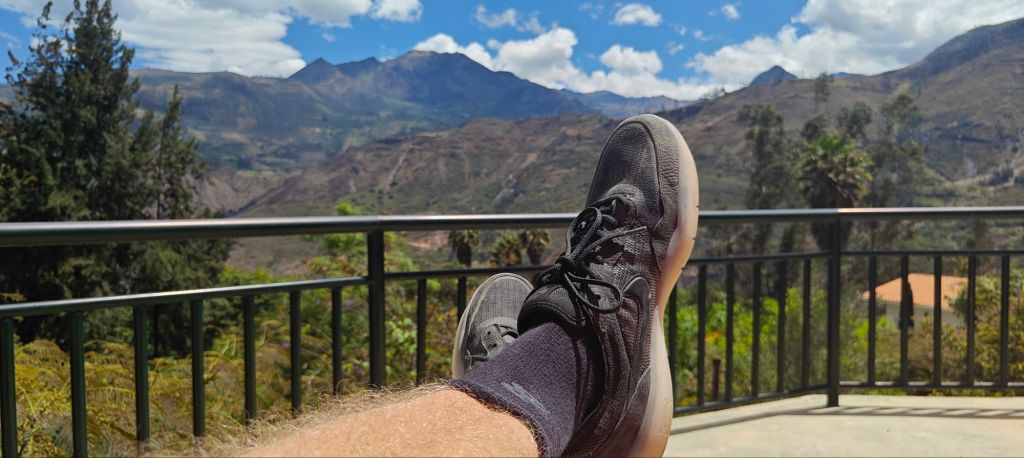
How I imagined myself a few days into Dominican Republic life
After planning to spend my work month in Japan, the busy streets of Tokyo and language barrier soon became less appealing. Instead, I imagined myself taking island life, eating hearty food, swimming in the sea and enjoying the slower pace.
Considering I had come home after my trip to Italy feeling more fatigued than rested, I didn’t want to repeat that feeling. Although I think the fountains of espresso and cornetos I consumed were more to blame than anything else.
Mind you, I did come away acknowledging my great choice in footwear, the New Balance 475s. So this time, I was eager to ensure my decision was just as spot on.
Having enjoyed my time at Dominican eateries in both Camberwell Green, Brixton and Stockwell, the food and friendly restaurant owners assured me that I was making the right decision.
It also helped that the national language was Spanish, so getting into a series of gesticulations with confused locals was less likely than in Japan.
Me in Japan trying to be hip via the medium of sign languge
With it being my first time in the Caribbean, I needed my footwear to keep up with the changing climate. The blazing sun and heavy spells of rain meant a large part of my collection would not pass muster.
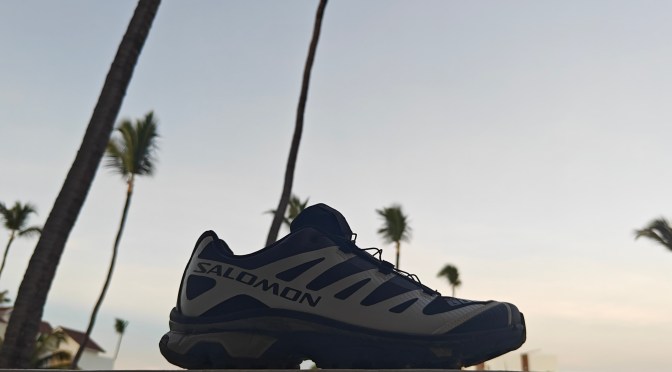
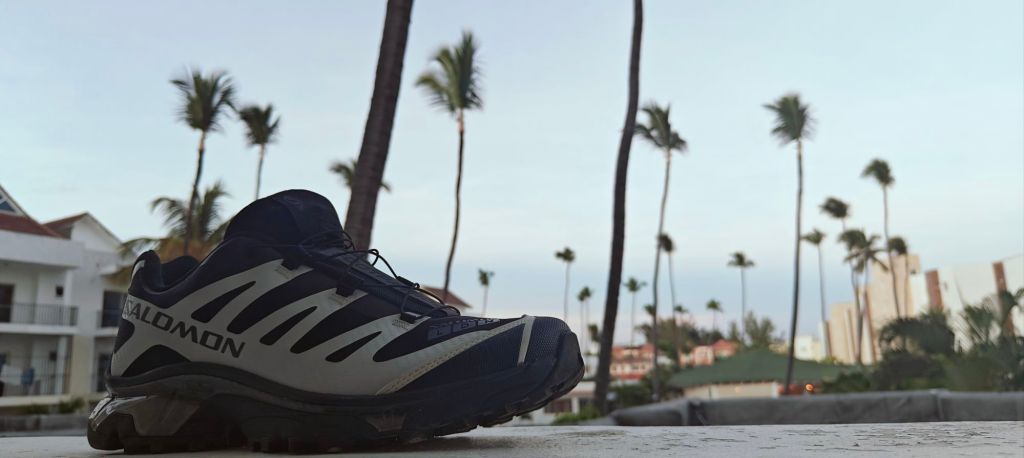
The XT-4 with the Dominican sky as the backdrop
Whittling down my shoes to several off-road and GORE-TEX-laden uppers did make things easier, but it did render my stack of soft suede New Balances out for the count.
Luckily, I was recently sent the Footpatrol x Salomon XT-4s from a good friend (also known as ‘The Captain’), a pair that instantly floated to the top of the decision pile. Not only could the Footpatrol XT-4 keep up with the changing terrain, they also looked the part.
a movie scene my friend often refers to given his self-proclaimed title
I did have two minor gripes with these Salomon XT-4s, the first being that they were half a size small.
I always go up by half a size with Salomons, a choice I recommend for anyone considering of picking up a pair, whether it be the XT-4, XT-6 or even XT-Quests (all with the exception of the XT-ALP).
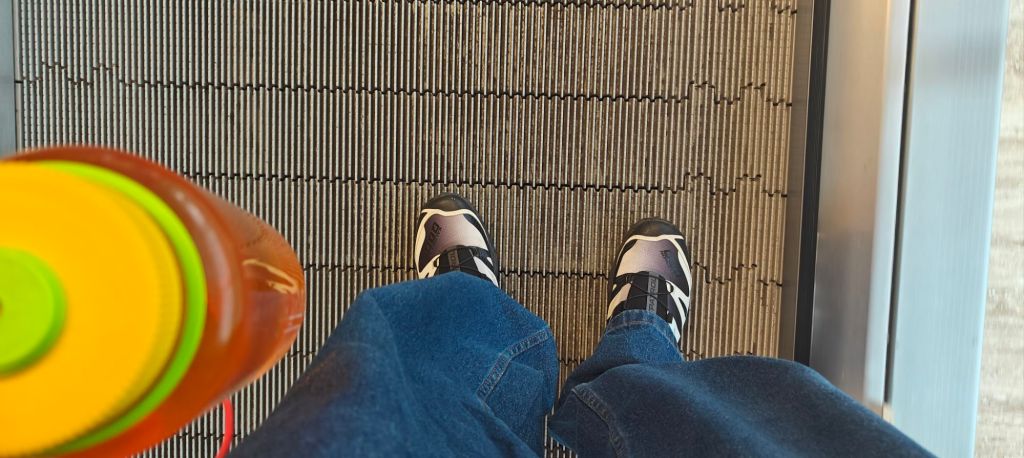
using my new Footpatrol x Salomon XT-4s at the airport, nothing screams independent like a Nalgene water bottle
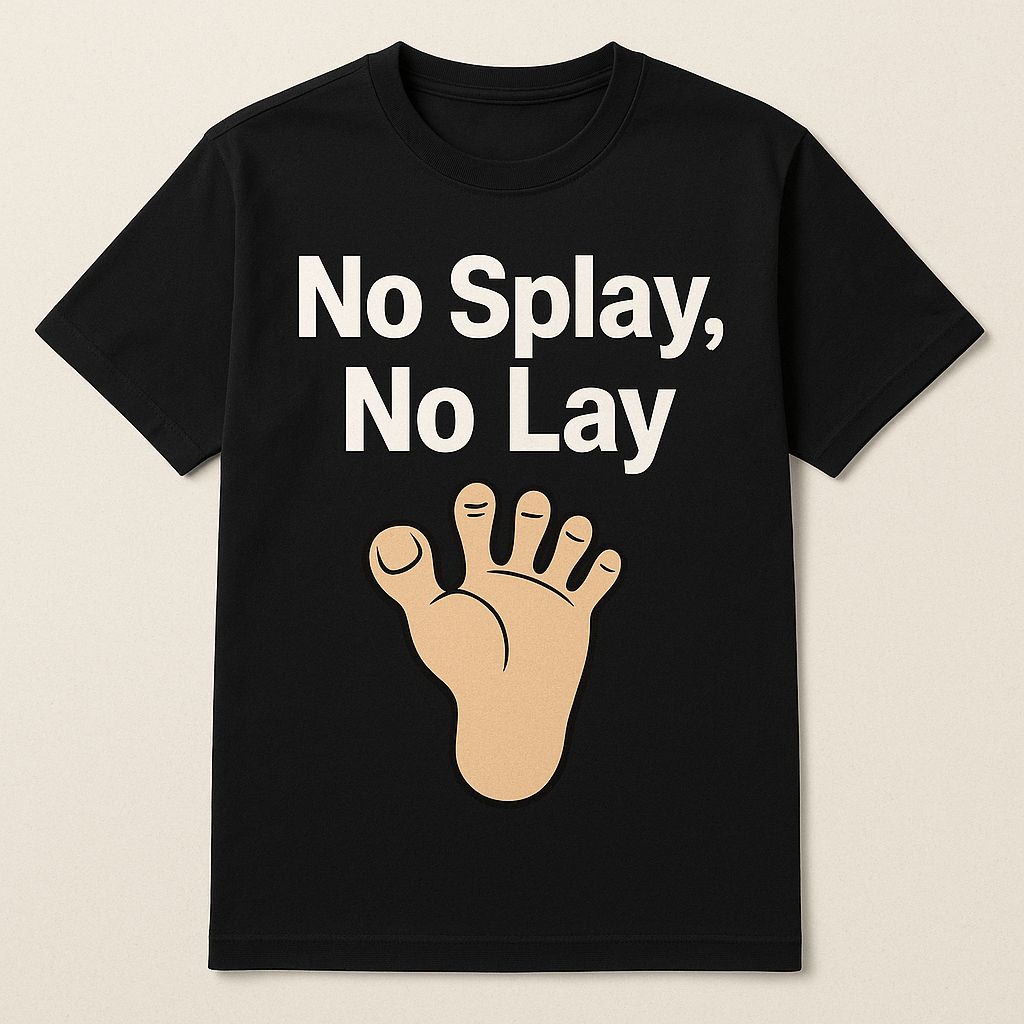
While there was enough room in the toe box, which allowed for my toes to splay (“no splay, no lay” – custom T-shirts in bound btw), my big toe was a little constrained (for the foot-fetish-inclined, this is about as spicy as the article will get, so you can leave now).
The second gripe was that it was an obvious choice. As the Salomon XT-6 is usually a go-to for those UK and EU residents who venture to other parts of the world, they skirted the ‘played-out’ vendiagram (likely rendering them ‘uncool’ circa 2027, see below).
Average Salomon XT-6 wearer in 2027?
On the other hand, the XT-4 was the less handsome brother of the XT series, often skipped due to its bulky nature. The XT-4 is the slightly overweight brother at the dinner table who makes everyone laugh with his infrequent quips. For example, “expect nothing more, expect nothing less!”, in response to his mother bringing up how her work colleague who soiled herself (also not appropriate for the dinner table mum, do better).
If I’m being totally honest, I would be the youngest sibling archetype, a character who hasn’t even made it to the table yet, as he finds himself scaling the ceilings of the next-door bathroom.
I fear I may have strayed off into the demonic there, but you get the gist. And while we’re here, the slightly demonic younger sibling in this case would be akin to the Salomon Alpinway Advanced. Please do not ask me how or why.
Anyhow, walking down to the station with both Osprey bags on (roughly 20KG), I stood on the platform with my feet really feeling the squeeze. Regret over my decision started to sweep in as I considered heading back home and reaching instead for my Meindls. While the Caracas GTX allowed for more splay, it would have been harder to convince passersby that I wasn’t a geriatric German who had just aged well. A look I am not scared to adopt in the slightest but one that I will try to keep at bay for the next twenty years.
Opting for swag over the safety of technical German footwear, I loosened the Quicklacing system which fixed the issue at hand. No longer did I feel my feet swell, so from that point on, the Kevlar lacing system remained loose, which also allowed for great slip-on/slip-off access (a detail all the coolest of cats appreciate).
FP XT-4s against a beautifully ageing stone floor and wonderfully hip plaid shorts
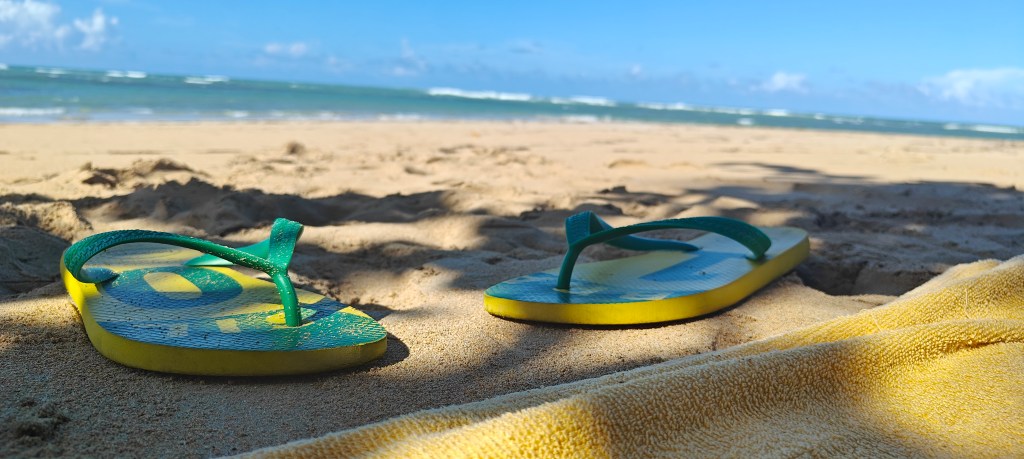
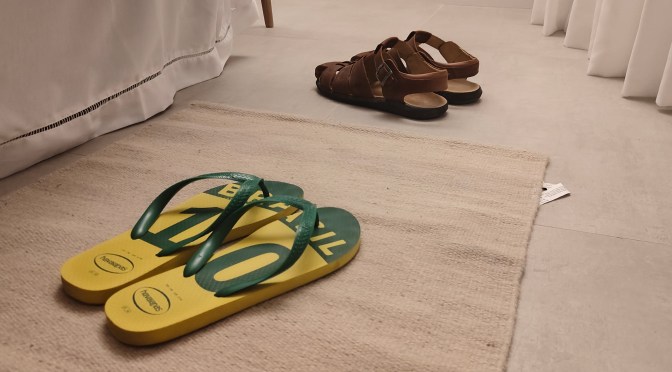
Landing in Punta Cana, it wasn’t long before my Brazil-edition Haiviannas were out and touching Dominican soil. From that point forward, the Salomon’s were allocated to evening dinners.
My R10 Havianas posted up on Punta Poppy in Las Terrenas
In truth, I’d have spent more hours in flip-flops had it not been for the cultural stigma of eating food with your toes out. Consequently, my dream of having a #ToesOutAutumn took a real blow. Not to mention the link between tourists and their short-wearing tendencies.
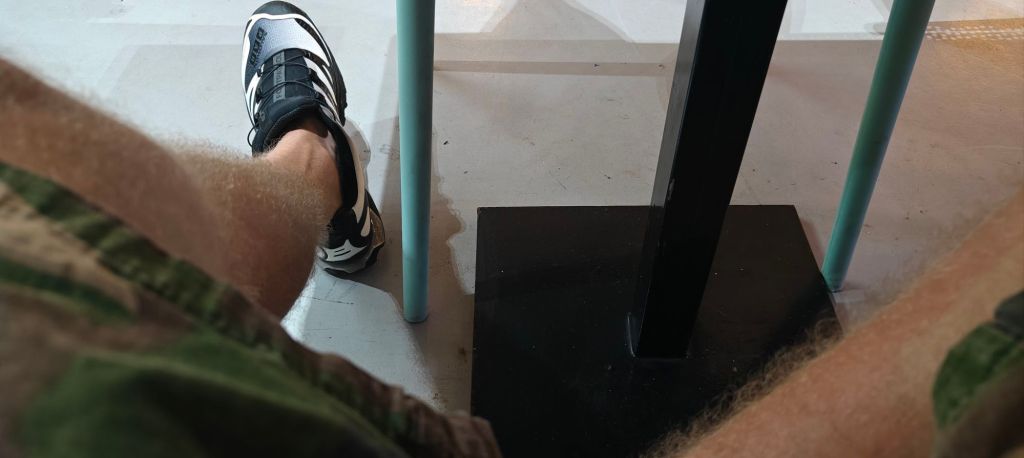
Me out in Punta Cana enjoying an evening meal in my aforementioned camo shorts
While the quasi-Tn fade of the XT-4’s upper is wonderful to look at, a trait which also separates this Footpatrol version from your standard XT-4, I think it may have been too strong when paired with my array of patterned clothing.
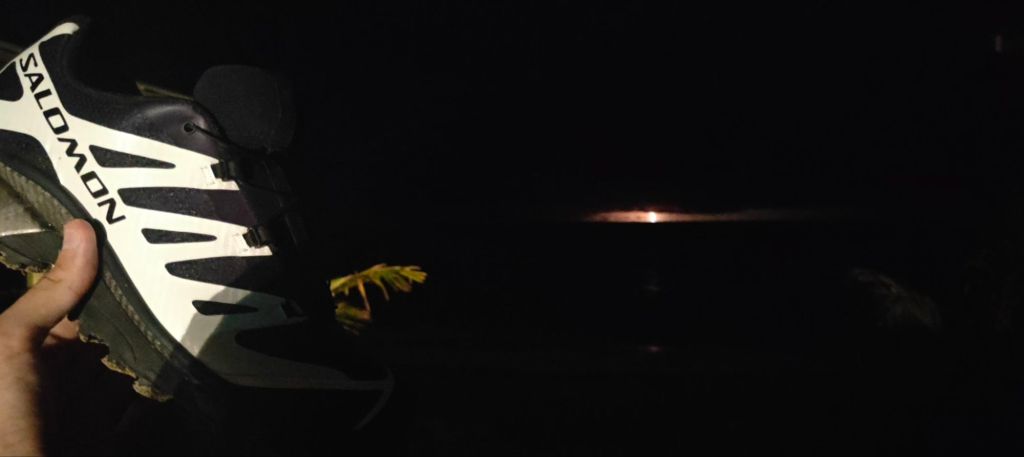
The Footpatrol XT-4s and I taking in the Dominican lightning and thunder storm happening offshore in Las Terrenas
Evening attire would consist of my Airwalk camouflage shorts that I picked up at Aldgate market and a bright graphic T-shirt. This made me stand out in a way that I hoped to have avoided, while also reinforcing my connection to autism.
Clutching my plastic bag from the local supermarket, a tactic I often employ when trying to dodge the ‘tourist’ label, that was about as effective as an elephant wearing one of those classic glasses and moustache disguises.
Unlike previous trips, I didn’t get a chance to test out the XT-4s on sandy terrain, opting for my Inov-8 Terra Ultra G 270 as my running shoes. A poor choice in hindsight as these were another obnoxiously loud shoe that I couldn’t rely on for fading into the crowd.
Not bringing a hybrid shoe that would suit my running and everyday needs was a silly mistake. While the XT-4 was a trail running shoe back in its heyday, the chemical compound used in the midsole had likely been altered since it shifted into Salomon’s Sportstyle category (like the dual-density foam 35 Shore A and a 25 Shore A mix on the XT-6).
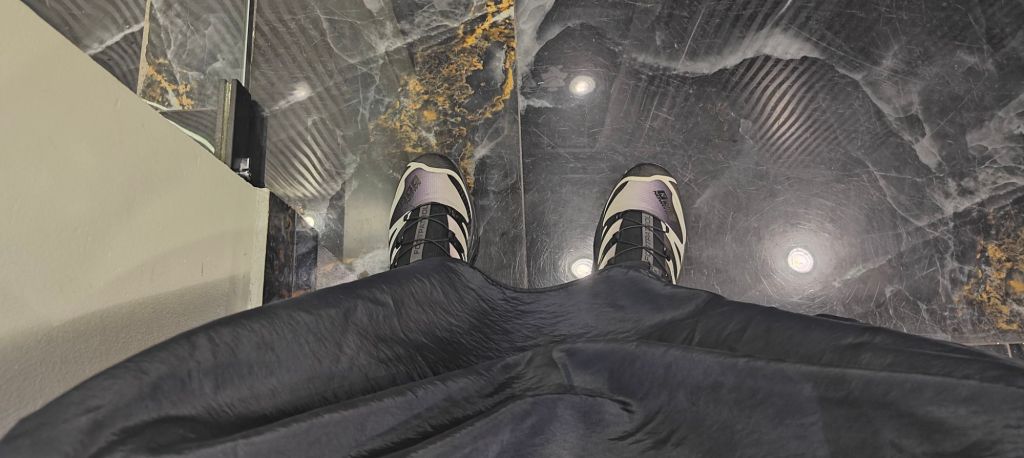
getting a much-needed haircut in the Footpatrol Salomon XT-4s in Santo Domingo, peep the marble floor, wowee!
You even hear some people complaining about the XT-6 and XT-4’s terrible traction, which is crazy considering the shoe used to be a trail running shoe for competitive athletes. Not to mention its use of Contragrip Mud outsole which seems a little overkill for city-based commutes.
The Footpatrol XT-4s were reliable, giving me nothing to complain about throughout the many inter-city coach journeys. From Punta Cana to Santo Domingo to Las Terrenas to Santiago de los Caballeros to Puerto Plata and then back, the Salomons kept up.
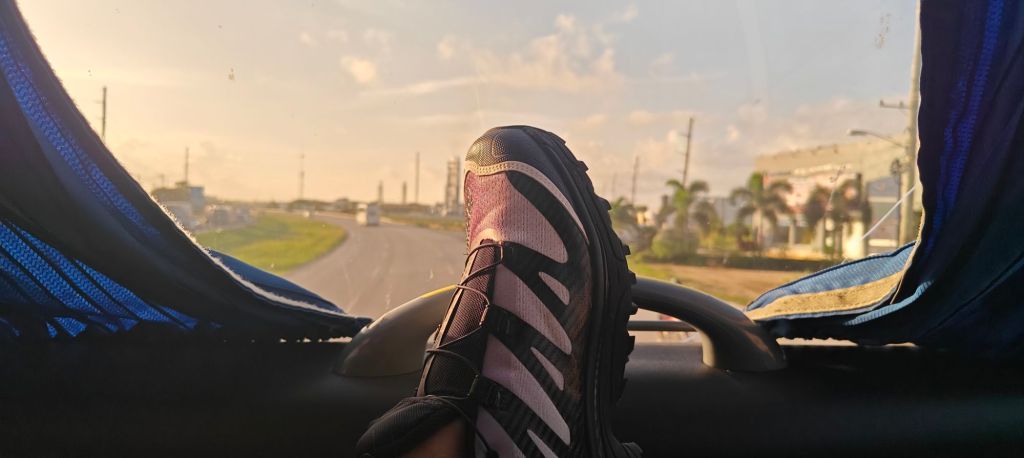
The Salomon XT-4 taking in a Dominican sunrise from the top deck of a bus headed to Santo Domingo
Although, I didn’t go on any hikes or scale up any hugely challenging terrain, its limits were rarely tested. There was one instance where clearing out the caked mud within the webbing channels proved inconvenient, but it was worth it for the small portion of Santo Domingo’s Botanical Gardens that I saw.
Enjoying Santo Domingo’s Botanical Gardens in the XT-4s
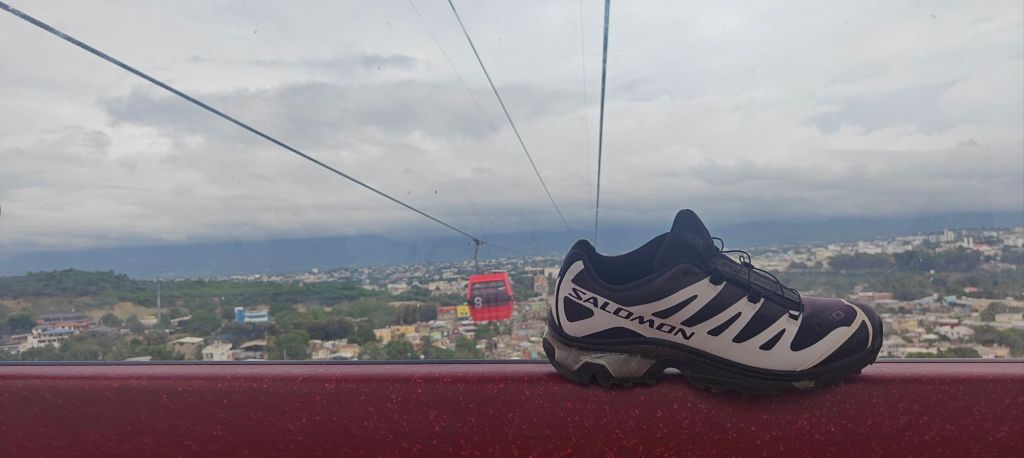
The Footpatrol XT-4s enjoying a well-deserved ride on Santiago de los Caballeros Teleferico
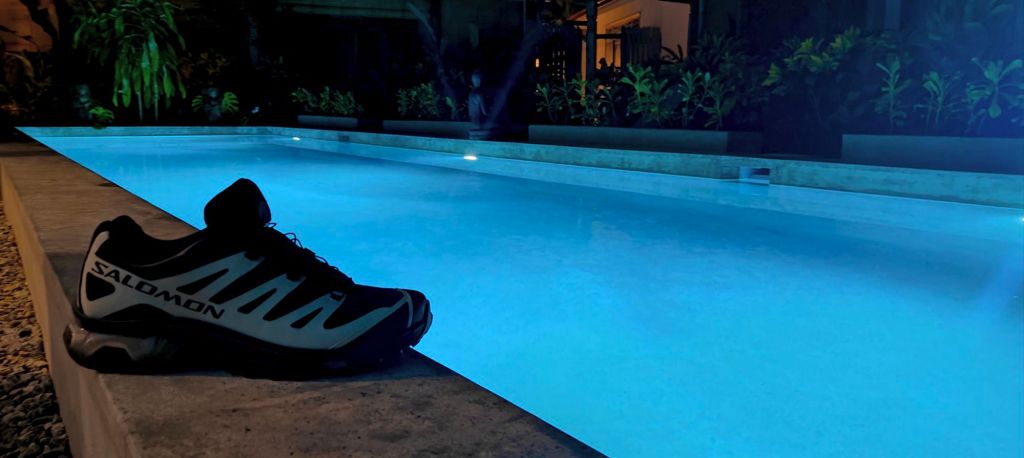
Sat poolside in the Bali-style Boutique hotel in Las Terrenas
I would recommend the Salomon XT-4 for anyone considering it as a travel shoe. My only recommendation is to go up half a size and to pick a colourway that would suit your wardrobe. If you’re inclined to wear a lot of stripes then perhaps go for a more subdued colourway with browns and blacks. If you’re trying to turn up like Adam Sandler, then pick something wild and hit the yolo button everytime you step out the door.
From public libraries, beachside restaurants and exploring cities, it was all within the XT-4 stride. I was never turned away for looking too informal, yet I can imagine the shoes being a slight issue were I one for the finer things in life. They canny turn you away from a beachside BBQ spot for wearing a pair of wicked Footpatrol shoes.
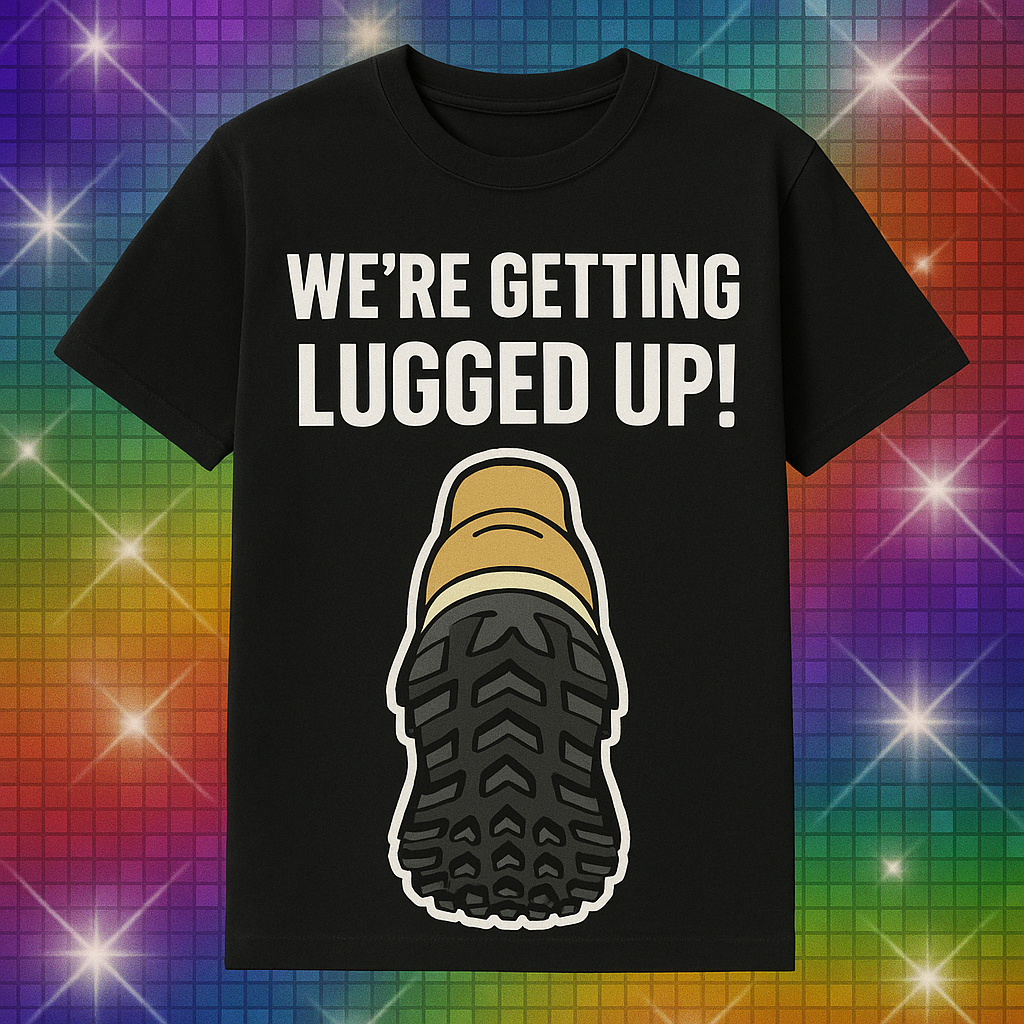
Strict dress codes at the club or exclusive restaurants would have proved difficult, so if you do like to dip in and out of fancy spots, consider this when copping a loud colourway of the XT-4s. If it’s super fancy, then chances are they work on a ‘got lugs, no spuds’ policy. And you know how lugged-up the XT series are.
Someone give me a job at a footwear-inspired t -shirt making company already!
The Footpatrol XT-4 is still my favourite colourway and collaboration within the silhouette’s library, but if you fancy something low-key then the Salomon website has many muted options.
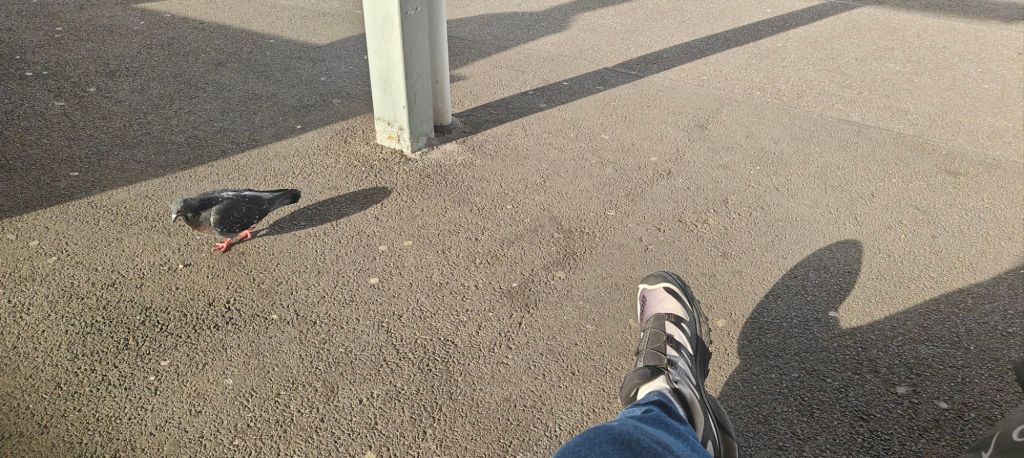
Headed home, the pigeons at Clapham Junction station were less excited about the Pigeon-esque hues of my XT-4s
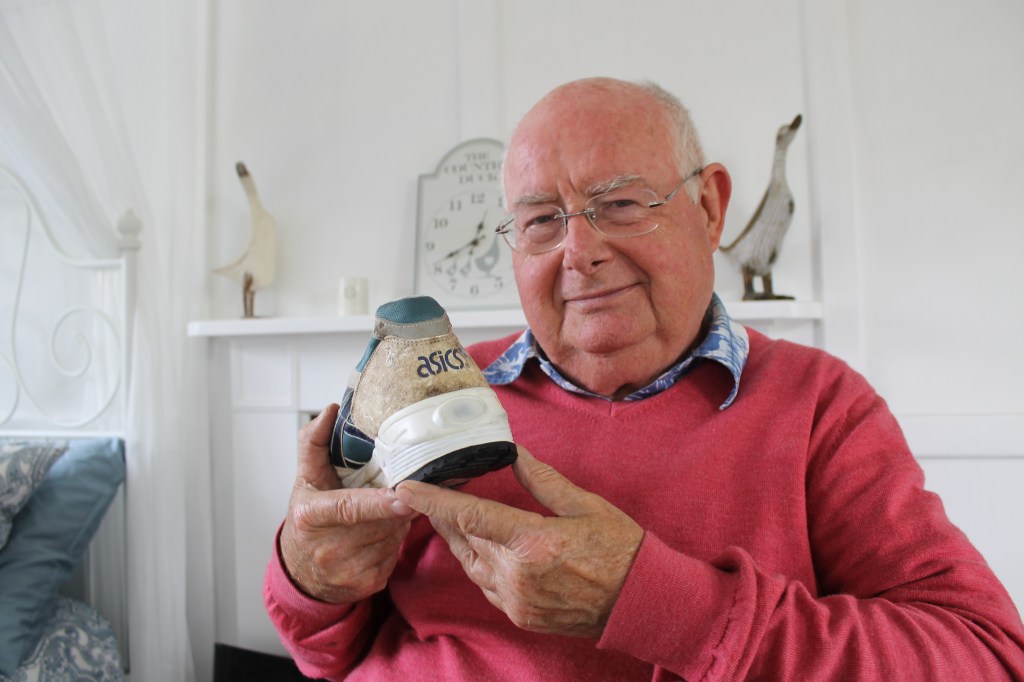
Photo of John Mott holding Light Up ASICS prototype LOT 1 using a piezo-electric componant
John Mott: Inventor of the First Light-Up Shoe
The ASICS GEL NITE-LYTE, released in 1993, holds a unique place in sneaker history. Long before children’s light-up shoes became playground staples, the idea came from John Mott, who believed footwear could improve safety for kids and runners at night.
Working with Pennwalt USA, Mott developed piezo-electric film technology that could harvest footstrike energy to power an LED. Unlike later mercury-based systems, Mott’s design was safer and more advanced. ASICS purchased the concept and integrated it into its GEL performance line, resulting in the world’s first production light-up running shoe.
ASICS GEL NITE-LYTE at the Olympics and on TV
The NITE-LYTE wasn’t just a lab experiment, it made global headlines in the early ‘90s.
Featured on BBC’s “Tomorrow’s World”, which showcased futuristic technologies.
These appearances cemented its status as a symbol of innovation.
ASICS GEL NITE-LYTE Design and Technology
According to a German ASICS’s NITE-LYTE advertisement (Art. No. 400 020), the NITE-LYTE combined cutting-edge running performance with safety lighting technology:
Upper: Nylon mesh with Duraskin reinforcements and soft nylon lining.
Heel: Padded with an internal PVC counter housing the LED.
Midsole: Dual-density DuoMax EVA with GEL cushioning in forefoot and heel.
Electronics:Stride-Generated Electronic System using piezo film + chip, triggering a flashing LED each step.
Outsole: Full-rubber with hard-rubber inserts.
Sizes: Men’s US 6–12.
Essentially, it was a fully-fledged ASICS GEL runner equipped with built-in night visibility technology.
ASICS NITE-LYTE vs. LA Gear and Reebok Innovations
It also paralleled Reebok’s piezo-electric experiments in the early ‘90s, where designer Steven Smith tested piezo-electric valves for the Pump system. Costs would have pushed retail prices to nearly $300 (≈$670 today), and prototypes lasted only 30 minutes before failing. Reebok’s CEO shelved the project, leaving ASICS as the only brand to put piezo-powered footwear into production.
Colorways, Archive Samples, and Sneaker Freaker Rediscovery
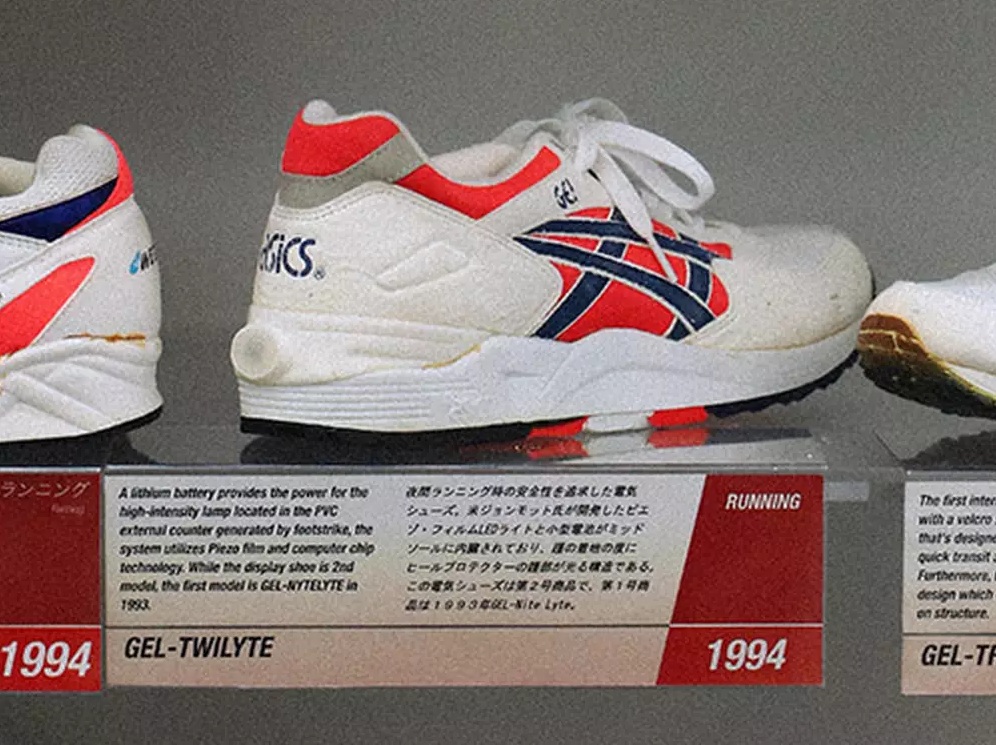
Today, the White/Yellow colorway is the most remembered, appearing in Sneaker Freaker Issue 48: “It’s Lit!” and in John Mott’s original samples. Below is a photo from the ASICS Archive in Japan that shows the ASICS GEL-TWILYTE, the successor to the NITE-LYTE.
photo via HIGHSNOBIETY and ASICS Archive
Above the description reads: “A lithium battery provides the power for the high-intensity lamp located in the PVC external counter generated by footstrike, the system utilizes Piezo film and computer chip technology. While the display shoe is 2nd model, the first model is GEL-NITE LYTE in 1993.”
The Japanese bio reads: “夜間ランニング時の安全を考案した運動靴。PVC製ヒールプロテクターに埋め込まれた高輝度ランプを、足の衝撃で点灯させる。ソールに圧電フィルムとコンピュータチップ技術を採用した。展示のモデルは第2号で、初代は1993年GEL-NITE LYTE.”
For decades, only one surviving pair sat in the ASICS archive, until sneaker media spotlighted the shoe again. Collectors recall them fondly:
“They did light up at the heel. Had the ASICS GEL white and yella wans, great guttie.” This rediscovery highlighted the NITE-LYTE’s role as a lost milestone in sneaker history.
The Legacy of the ASICS GEL NITE-LYTE
The GEL NITE-LYTE was more than a gimmick, it was the world’s first performance light-up running shoe, decades before wearable tech became mainstream.
Invented by John Mott, driven by child safety.
Adopted by ASICS into the GEL line in 1993.
Showcased on a global stage at the Olympics and BBC television.
Predated LA Gear Lights and foreshadowed Reebok’s piezo-electric research.
Remembered as a rare, recalled, but revolutionary sneaker experiment.
While the story is largely unheard of among sneakerheads, it still remains a symbol of bold experimentation in 1990s sneaker innovation, proving that visibility and performance could be fused in one radical package.
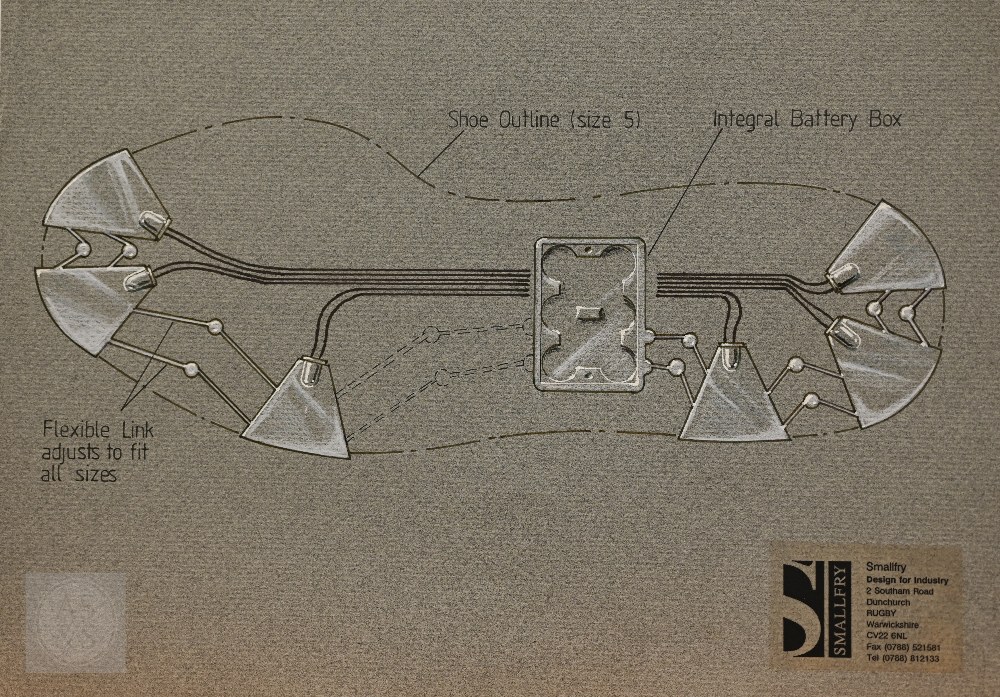
Now British Inventor John Mott is selling a number of his inventions at auction via the Andrew Smith & Son auction house. There will be nearly 140 Lots for sale including the Light Shoe Prototypes, Carbon Fibre Golf Clubs, Tennis Raquets and even the Concept drawings. The Lots will also be on display once the auction goes live, giving people a chance to see these amazing inventions in-person.
Schematic Diagram of Light Up Shoe by John Mott – Image via Andrew Smith & Son Auction House
This is an auction unlike any other and celebrates a lifesworth of inventions. The auction will start on the 5th of September 2025 and be live for 10 days. The Lots will all start at £0 and have no reserve, giving everyone the chance to own a piece of inventing history. Also up for sale are two mystery Lots in 15A and 15B, giving bidders the chance to get involved in something incredibly unique.
I went to my Uncle’s 60th in Germany the other day. It was a wonderful affair. Apart from celebrating, I thought it an apt opportunity to look out for abandoned shoes. Although I was travelling with family, meaning finding time to wander would prove difficult.
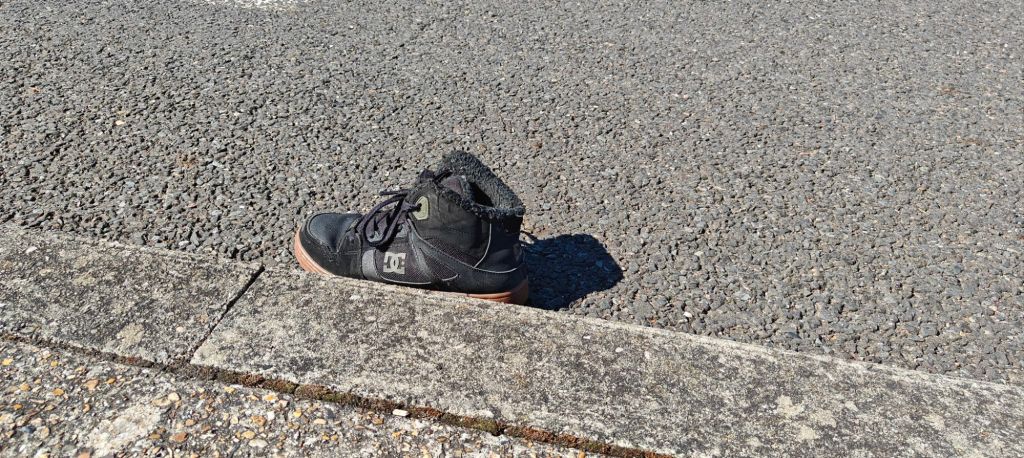
We took the car to the Euro Tunnel to get over to mainland Europe. Big slay. The journey started off on the right foot (pardon the pun) thanks to one discarded DC high-top sitting next to the awaiting cars. Either some Roadie had decided to part ways with it before starting a mind-bending metal tour in the EU or some kid lost it by sticking his foot out the car window. I’m think either excuse would suffice.
Unfortunately, this would be one of only two shoes I would come across during the weekend trip. Many shoes were dotted along the roadside but due to the fact that we were whizzing past in the car, I was unable to snap a photo in time. I did however notice an awful lot of flip flops, or thong sandals discarded along the French motorway.
Perhaps the Havaianas R&D team would benefit from a European road trip. Equally, any influencers promoting the latest #toesoutsummer trend might benefit from this excursion. Side note – is the flip-flop and jeans look authentically Scandinavian or is it a move from the ruling class so people forget they’re losing more money to taxes each year by the distraction of toe action. Suspicious right?
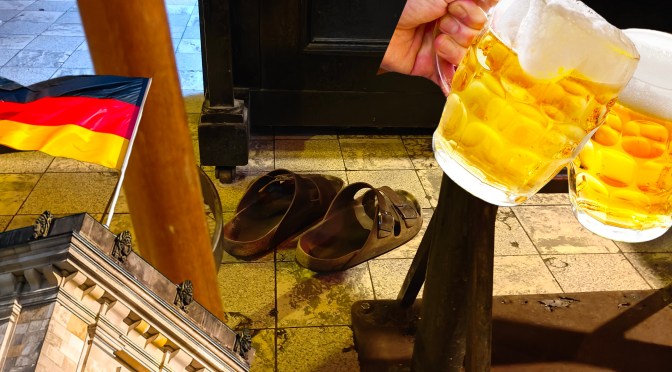
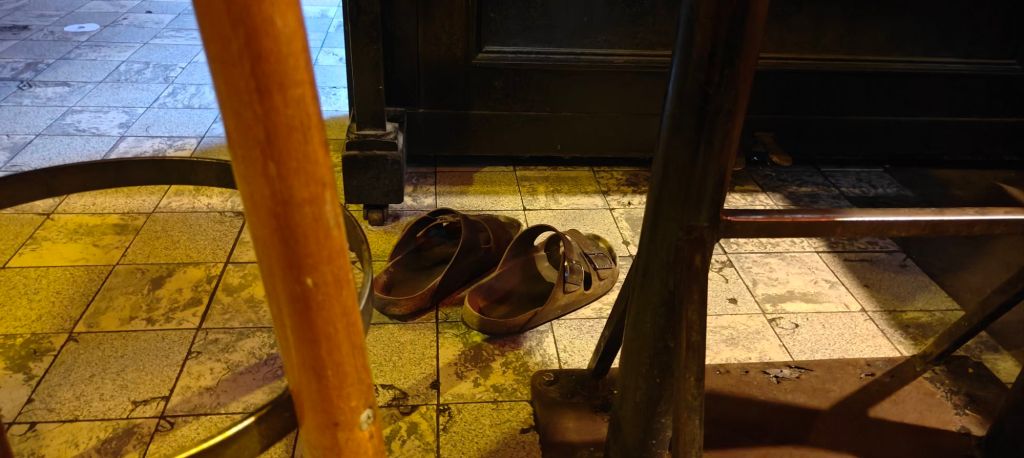
Needless to say, little to no abandoned shoes were photographed. Later that evening we found ourselves in a cash-only German dive bar. It was there that I spotted the most typically German footwear left on the tiled floor. Underneath the bar stools lay a heavily-worn pair of Birkenstocks, the Arizona to be exact. I didn’t get to find out to whom they belonged to either as they sat there alone the whole time.
I imagine the owner of the Birkenstocks was a local, someone who frequented the bar and enjoyed feeling the grooves underneath their toes that they put in the hours working for. My only other thought is that they were a memoriam to a bar-legend, but I was not willing to find out if they were glued to the floor. ‘Never touch another person’s Birkenstocks’ is a good rule to live by.
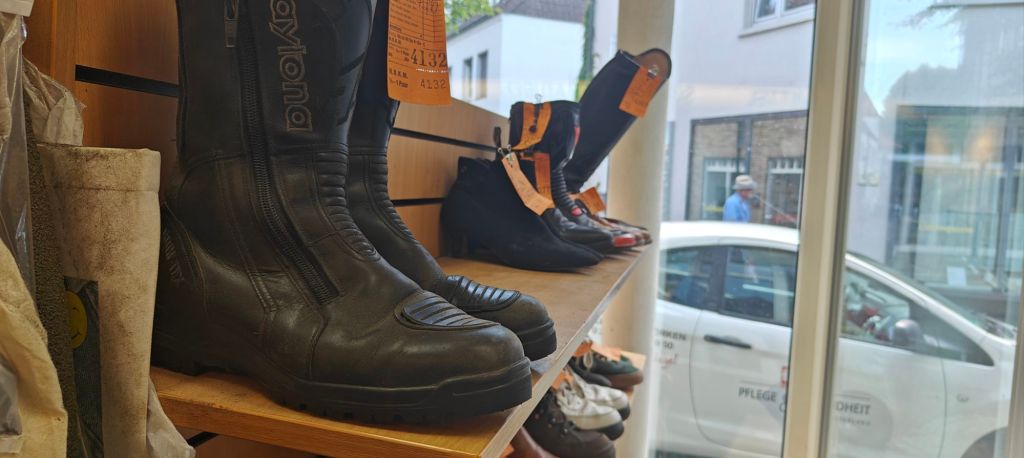
The next morning I retraced my steps around the town I had so often visited as a child. Walking down memory lane. All the toy and shoe shops seemed so much smaller than I had remembered. I suppose this is the usual realisation for places people rediscover later in life. I loved it all the same. In fact, it had become more charming a place than I had remembered.
My Uncle, reluctant to splash out on a pair of shoes for my other Uncle’s party asked if I knew of any shoe repair shops in the area. While my shoe knowledge is extensive, I would be lying if I said that I had a sixth sense for where cobbler’s dwell. If I did I’d probably be rich. Or arrested.
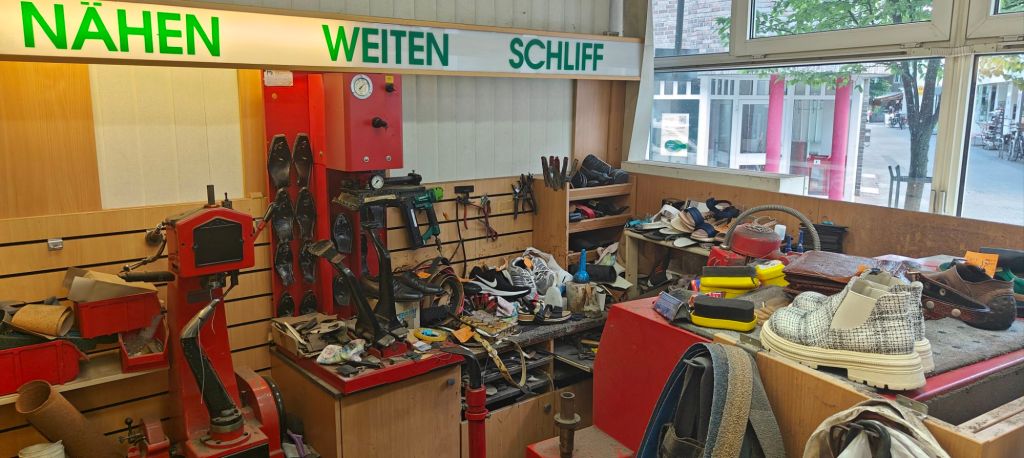
A quick Google later and we were in the first cobbler’s. A middle-aged German lady looked us up and down, realising we weren’t the usual clientele. My Uncle, pointing at a loose stitch on his forefoot, gestured for help, to which the lady pulled a face and said, “no sorry”.
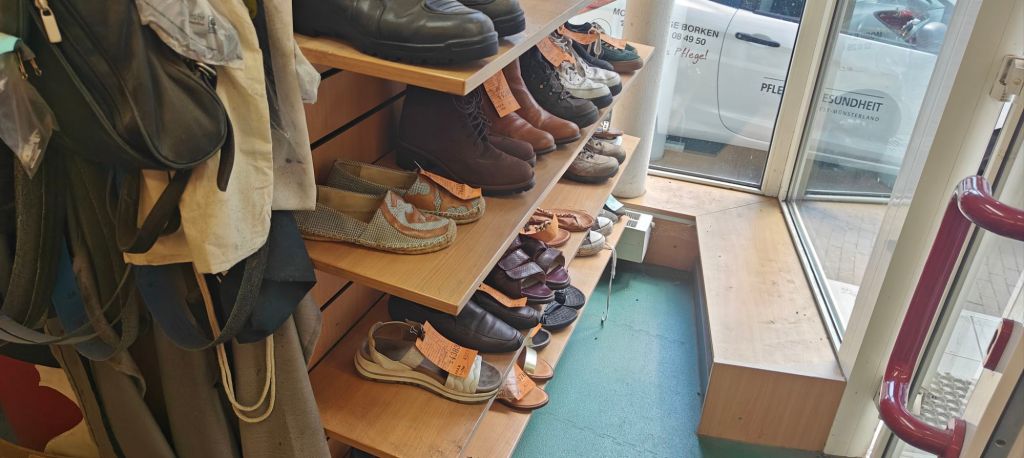
Not wanting to have completely wasted the journey, I asked if I could take photos of the shop, which she politely invited me to do. I spotted a very snazzy pair of women’s shoes and asked if she knew the brand name. She shrugged, “I don’t know, I only repair the shoes.” A lady of few words. Germans are known to cut to the chase, allergic to dancing around the point, so I took no offence. Onto the next.
The other shoe repair shop was in the local mall a short stroll away. The man’s shop was small in comparison, more like a pop-up Timpson’s equivalent, although with fewer ex-convicts as staff members. Noticing we were interrupting a friendly catch-up with a local on a Saturday morning, we were hesitant about receiving help.
My Uncle did the same one-shoe dance, pointing to this somewhat broken shoe in his other hand. An animated point of the finger later and the German cobbler shook his head, “No sorry”. It seemed to be an easy response to fending off the English. They know we can never be offended if there’s a ‘sorry’ on the end of it. E.g. “I burnt your house down, sorry”. To which the standard reply would be, “All good, how’s the family anyway?”.
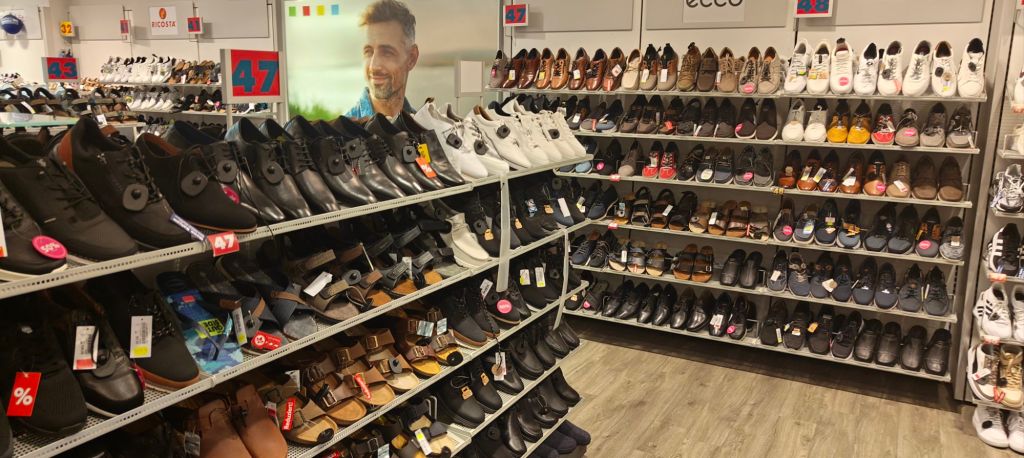
It was at this point that my Uncle conceded to buying a new pair, so off on a shoe hunt we went. Heading over to the next town, a place which had a bigger and better selection of trainers, spirits were somewhat high. Recruited as an impromptu celebrity shopper/stylist, I fuelled up on a mango and watermelon ice cream. I was on holiday after all.
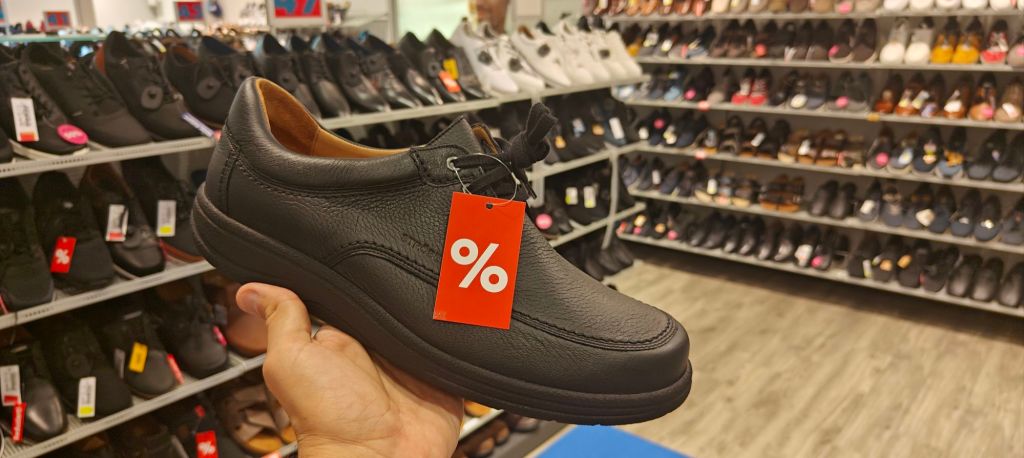
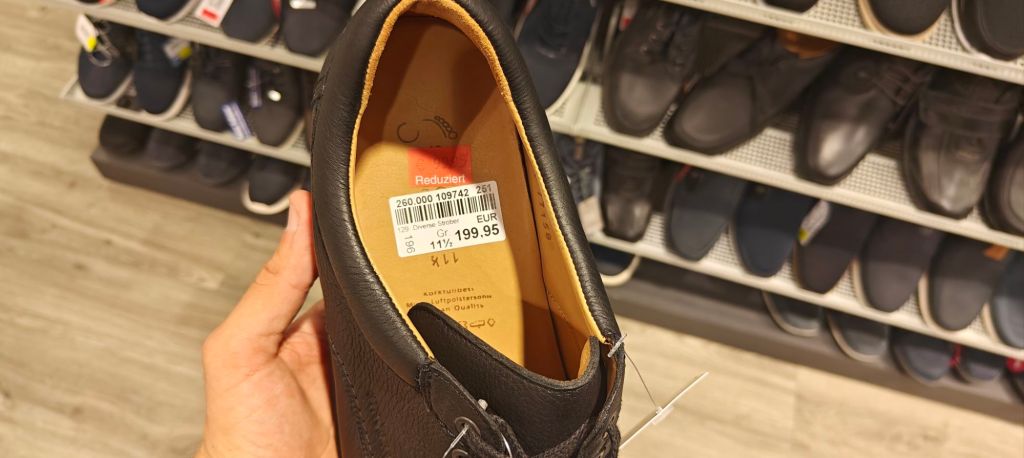
A lot of shops were full of very German-looking leisure shoes. Think Clarks but on steroids. Better yet, Clarks on a mild dose of antidepressants. It was here that I spotted a pair of formal leather walking Strober shoes. I knew little of the brand, but the shoe was so Grandpa, I was infatuated with it.
Suddenly ,my penchant for dad jokes and white socks made all the more sense. The only thing holding me back was the 99.95 Euro price point (discounted from 199.99 Euros), and the fact that my mum told me in a Peruvian-equivalent way that I would ‘look like a geriatric’.
Could I pull them off? I truly believed in that moment I could. A pair of loose sporty diabetic-friendly socks and some beige chinos, chef’s kiss (FYI I don’t have diabetes but I did accidentally buy a pack of diabetic socks in 2018 off Amazon, hence the reference). In hindsight, I am rather glad I didn’t end up purchasing them as it meant I could justify the pair later on.
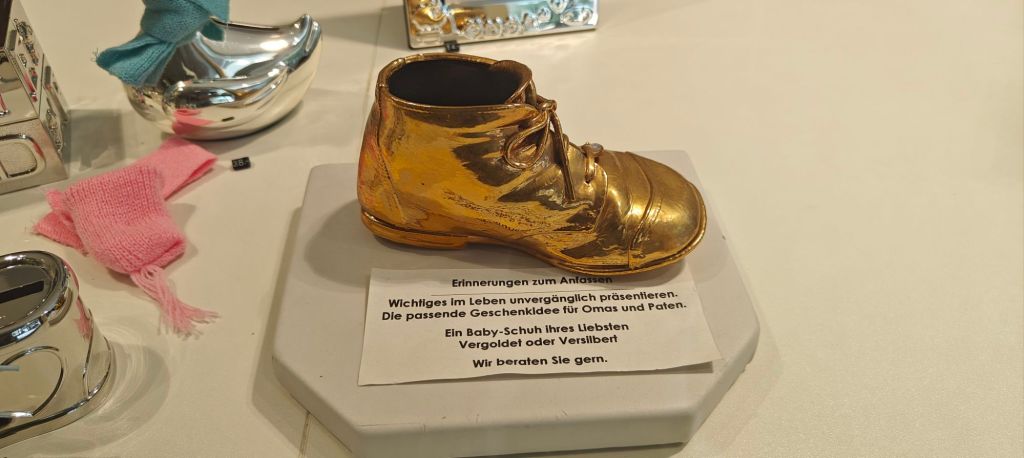
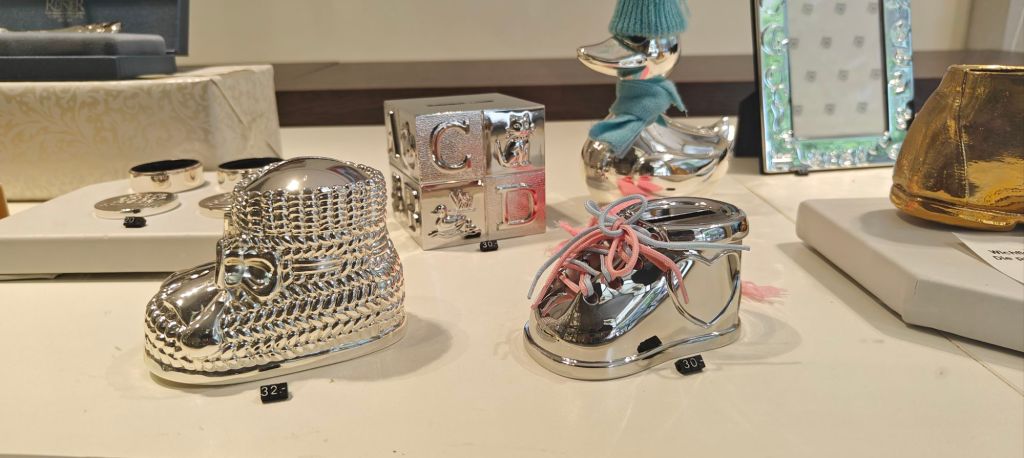
It was wandering around where I saw this golden boot (not a reference to Headie One’s hit song) and other silver baby shoes. I feel like if I got to the level where I justified buying these as house decorations, I would truly be ‘cooked’.
Here is an interesting sock packaging that I spotted in a souvenir shop. It was a very Japanese present in my mind. Would you be happy to receive this from your partner on Valentine’s Day? Let me know in the comments as I cannot figure out if these are a big yes or a big no.
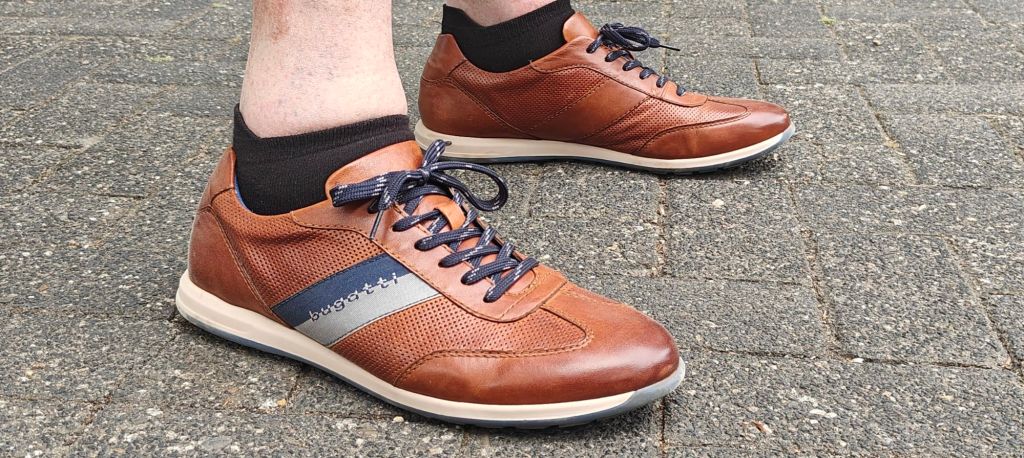
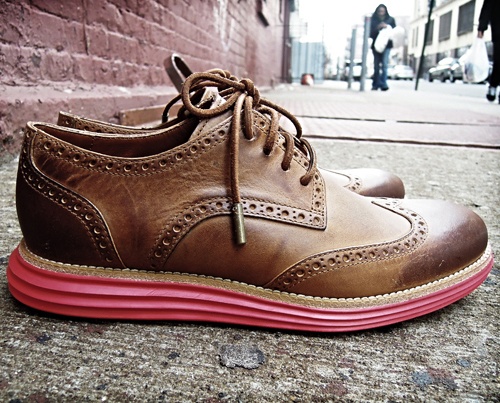
My Uncle did successfully purchase a pair of shoes for the birthday party the following day. Opting for a Bugatti formal/sporty shoe hybrids in a light brown, the mission was a relatively fun exercise. Even if he didn’t go for the more hybrid sole pair I was vouching for. They looked in the vein of the Nike Cole Haan hybrids from the early 2000s where you would get a formal shoe sat on a Lunarlon midsole.
image via Pinterest
Had I ever ended up in the finance industry, I’d have got a doctor to write me a note so I could wear these. That’s where the diabetic socks would have really come into play. In fact, maybe I should buy another pack for future health-related excuses. Is it a hate crime to dislike someone with diabetes? If not it should be.
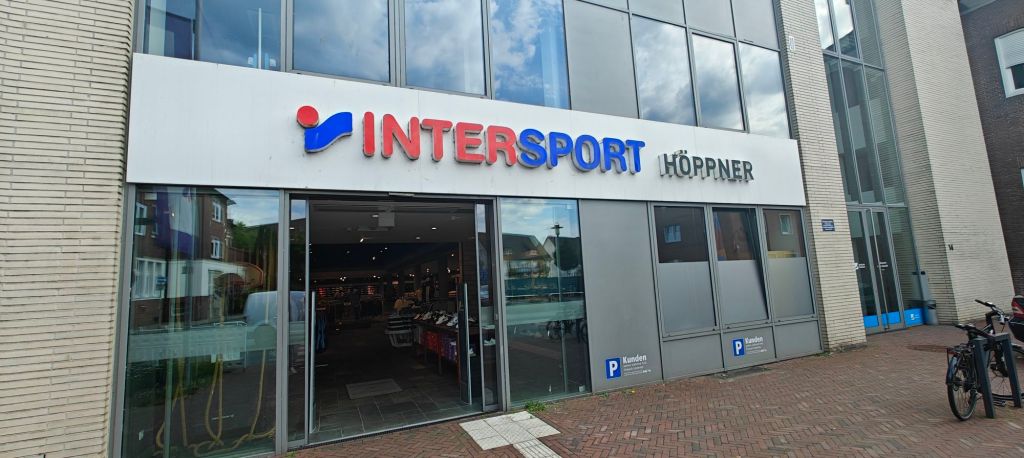
Getting back to the hotel, I decided now was the time to go for a wander while the rest of the squad went to nap. Darting straight for the local sports shop, I was eager to relive my childhood-sneaker epiphany by going to the sports shop that started it all. The only problem was I couldn’t remember which one it was or if it was still open. Regardless, I headed to the nearest Intersport hoping memories would come flooding back.
Solid Brooks running shoe selection at the local Intersport
Entering the shop triggered a deep sense of nostalgia. A distinct memory of helping my mum and auntie buy my cousin a pair of adidas football boots returned to the front of mind. Tracking through the racks, it was clear that the shop had a decent running shoe selection. I pored over the prices and sizes on display for almost thirty minutes before heading to the other side of the store where the hiking shoes were kept.
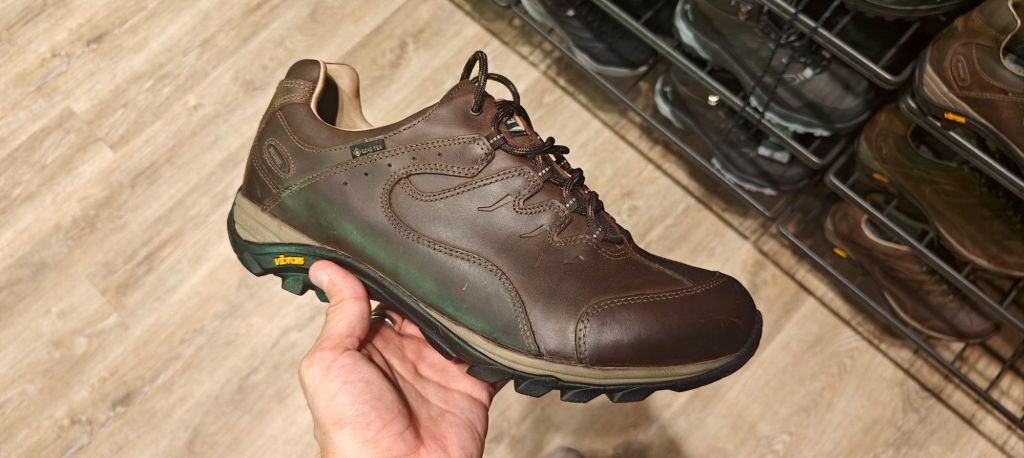
It was then that I spotted the Meindl glowing from afar. Long had I thought about this premium hiking shoe. It’s understated leather upper bowed in elegance and silently spoke to its marvel of German footwear making. I had strolled into many Outdoor shops in the UK to only stare at the high price point of the Meindl footwear selection.
Paying £175 was out of the question, yet the suede and tightly woven stitches called my name each and every time. Not to mention the leather GORE-TEX edition, which reached as high as £220. Now it was all making sense, acknowledging the top-tier quality and the way it poked its head above the rest. The 250 Euro price point was eye-watering but I was eager to find a way of making it happen.
The moment two stars had collided
I discussed the shoe with the Intersport employee, where she took out the insole to see how my foot fit against it. Opting for a bigger size to allow for any foot swell during a hike (hot I know) I went with the UK12.5.
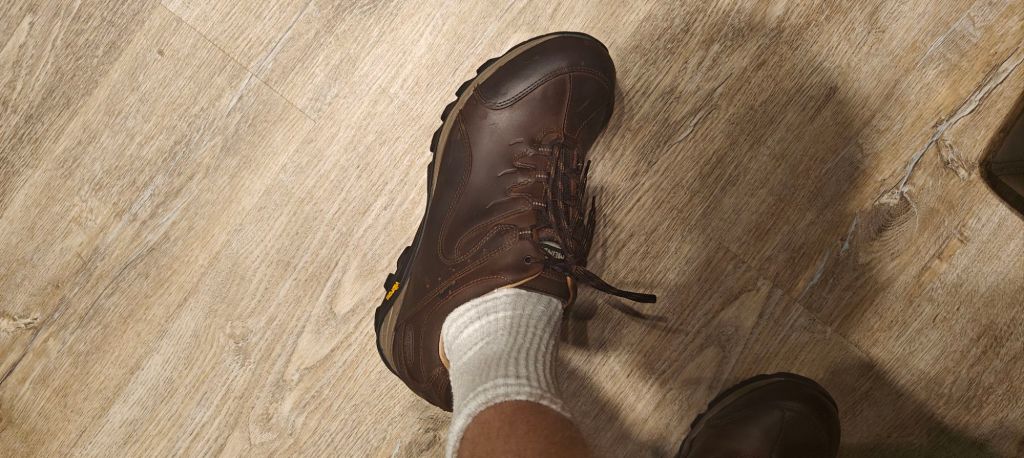
I also decided to go on the obstacle course, feeling no pinch points across the stone edges and wooden logs. I felt like a man in his forties testing out a pair of shoes for a grand adventure. Although I am still in my twenties, I am not the head of a family or a father to any children, so I was coasting on pure adrenaline (a slight exaggeration and artistic license are used here). I was in my element. I felt awesome, as the Americans would say.
The store assistant left me to umm and ahh as I tried to figure out how on earth I could bring down the price. One University discount, size-related discount and cash deposit later, the card machine read 140 Euros. I had won the game of life (or thereabouts).
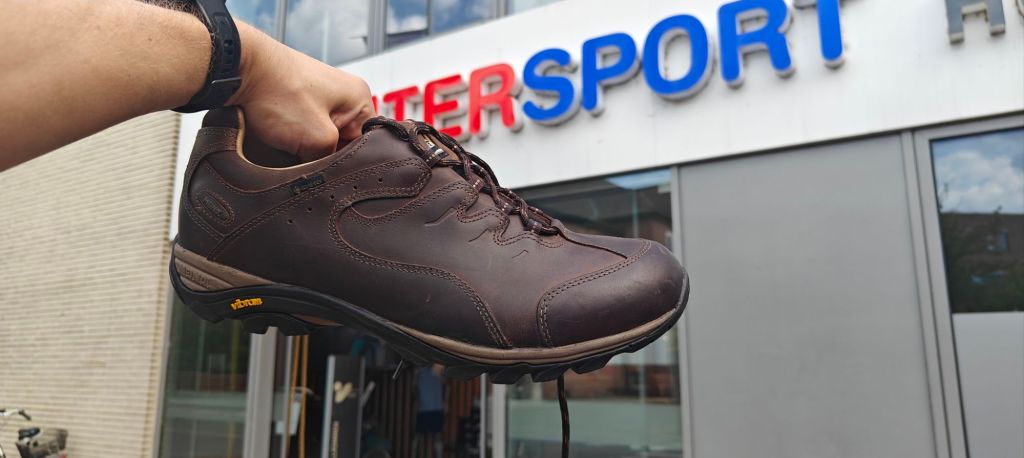
Walking out of the store, it was obvious that the stars had aligned. Not only had I returned to the mecca of shoes, the place that started it all (to be confirmed), but I had also managed to pick up the Made in Germany Meindl’s that I had wanted for years. Elated, I felt it was right to snap a photo and capture the moment.
Feeling a strong post-success hunger, I decided to walk to a fine kebab shop where I was able to pore over the quality upper in the town square. You can see the slightly confused lady in the background, either that or her face is one of pure envy. You can decide for yourself on that one.
The next day I told my cousin about purchasing a pair of Meindls. He laughed, stating he only knew that avid German hikers wore them, not really hip people in their twenties (not his exact description). I asked if he would ever own a pair, to which he replied, “If you ever saw me pushing a stroller in them, you know I am near the end.” I think the German craftsmanship was lost on him. Needless to say, I am absolutely chuffed with them and they look grand on foot.
Fond memories, cheap bakeries, good value double Espressos and a wander down my footwear-related past meant I was made up.
My Dad and I posted up on the block (like a lowlife?)
Lima is the capital of Peru. A city that everyone has to fly into to get to any and all of the country’s famous tourist sites. Fun fact: Peru is nine times the size of the UK, which gives you a sense of scale. I have only ever scratched the surface when it comes to what the South American contenent has to offer, rendering me anything but an expert so if you are after such knowledge then this may not be the place for you. That said, what I’m writing about doesn’t require you to leave Lima at all. Better yet, it is free. It is certainly not world-renowned like Machu Pichu or as historically significant as Sacsayhuamán, there is no kudos in seeing it, no bragging rights or boasting to your mates down the local boozer about it … the last of which would likely result in a few laughs on your behalf. Although noticing it is commendable or even noting it would speak volumes about your perceptive skills.
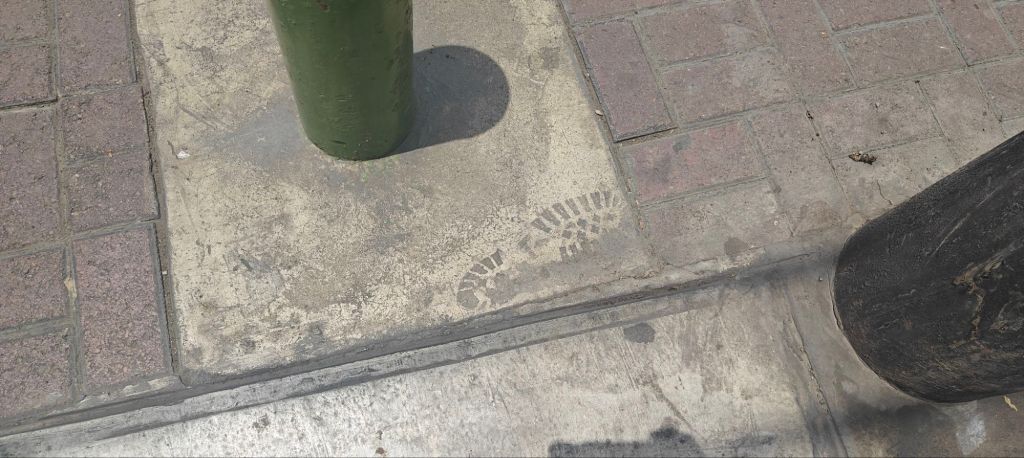
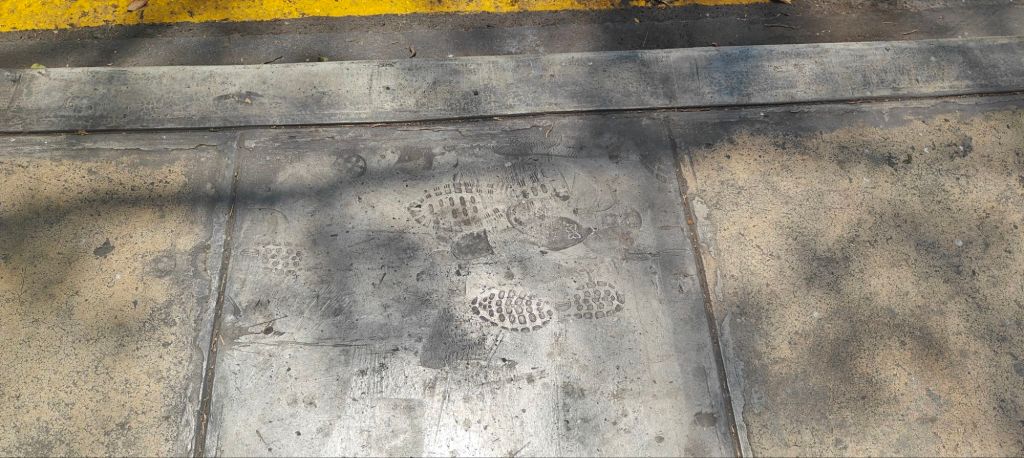
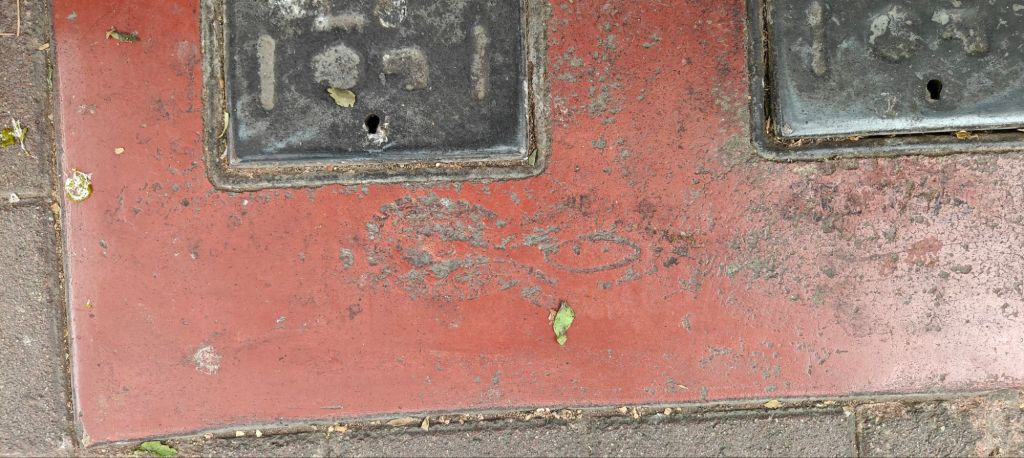
Walking around Lima, it is easy to get distracted by the architecture and distinct energy. For most, this will be your first chance to gather a sense of what Peru means to you, at least as far as city life is concerned. Lima’s pavements, sidewalks or la veredas are like any other city in so much as they get you from A to B. The concrete below your feet that interlinks the large metropolis feels like any other. It is hardly a tourist site in itself, a point I would hardly contest. However, if you’re fascinated by all things shoe-related then the streets of Lima might just be a fascinating space to you.
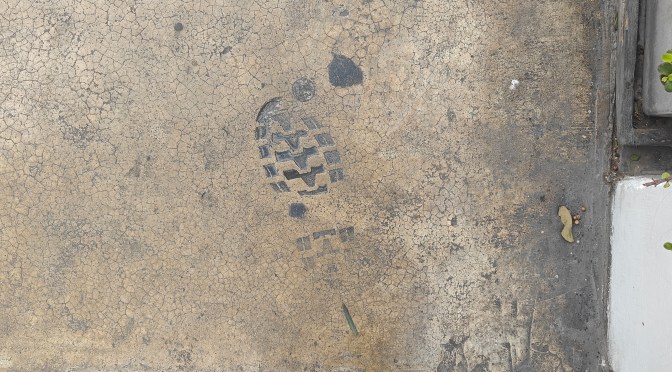
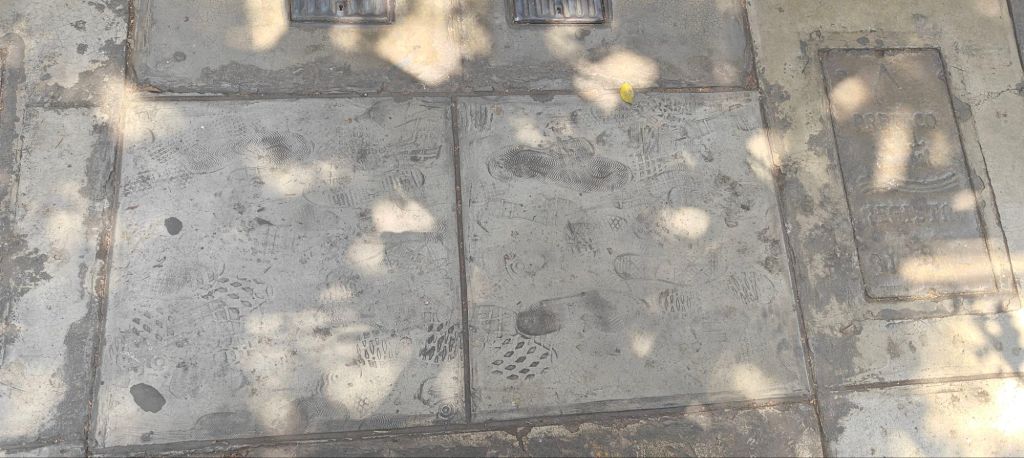
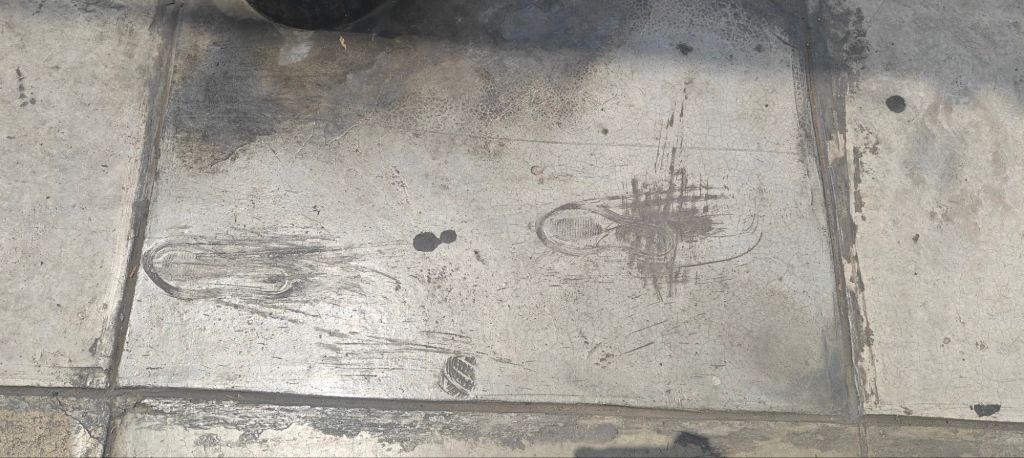
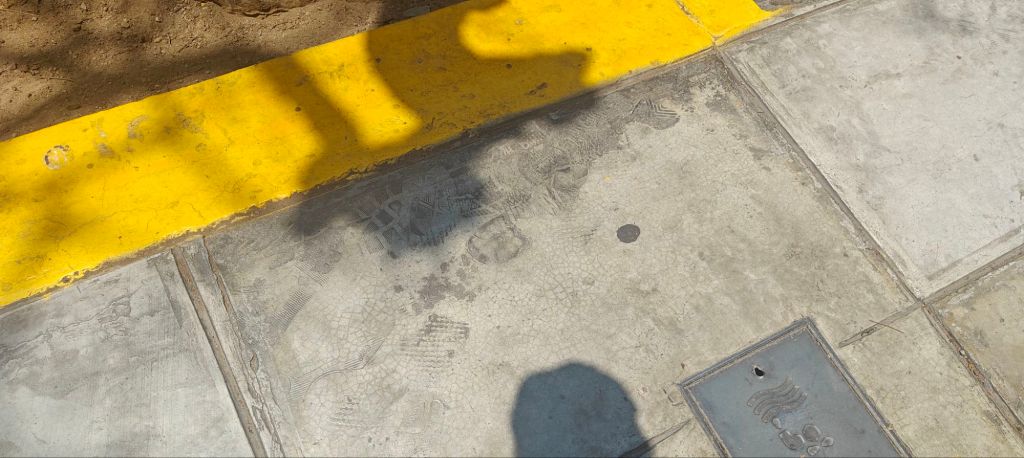
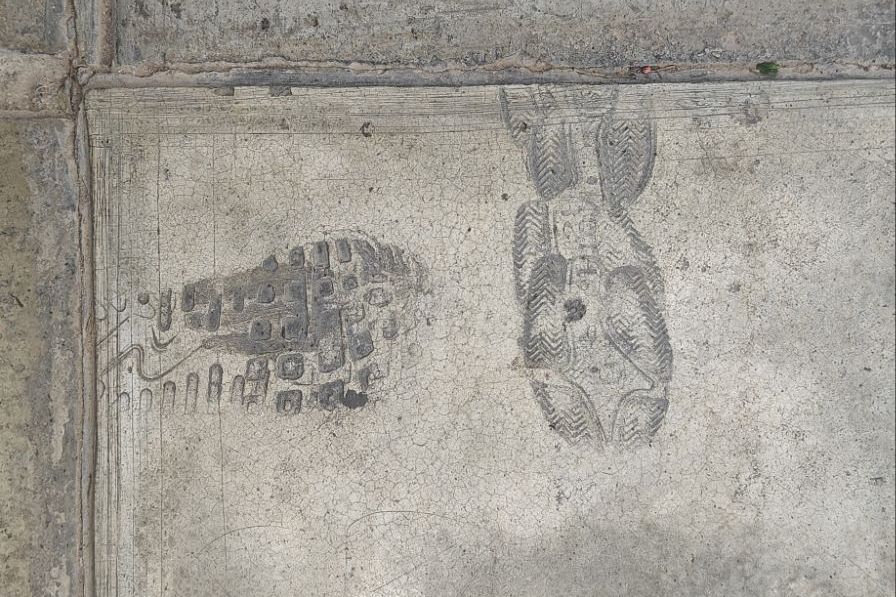
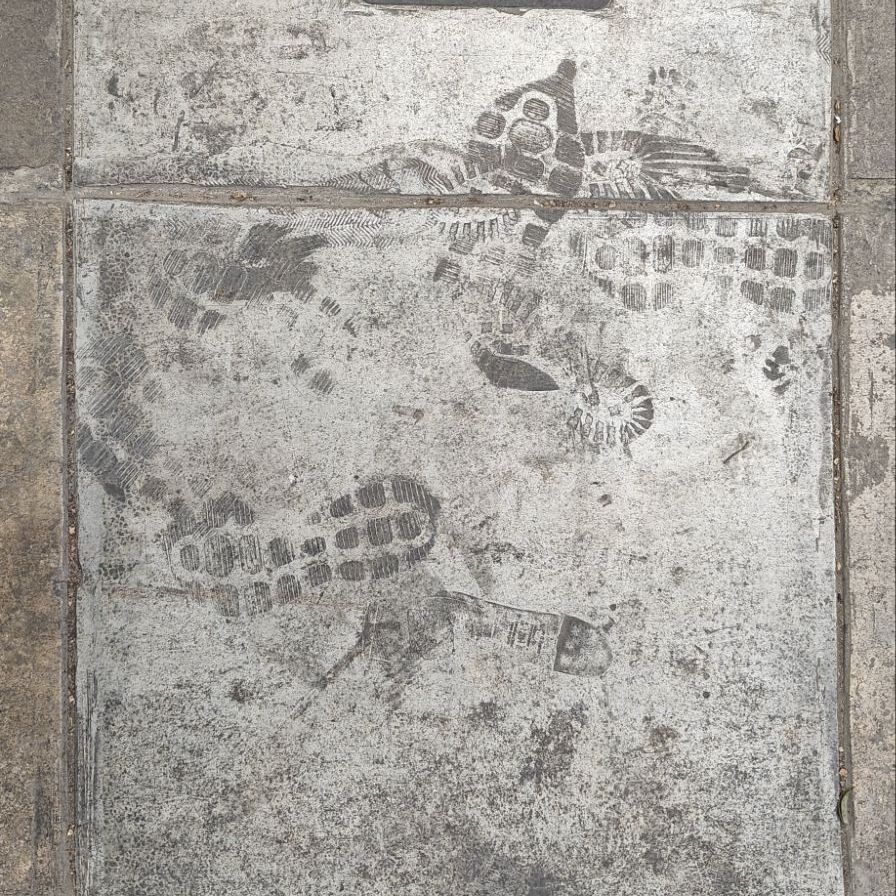
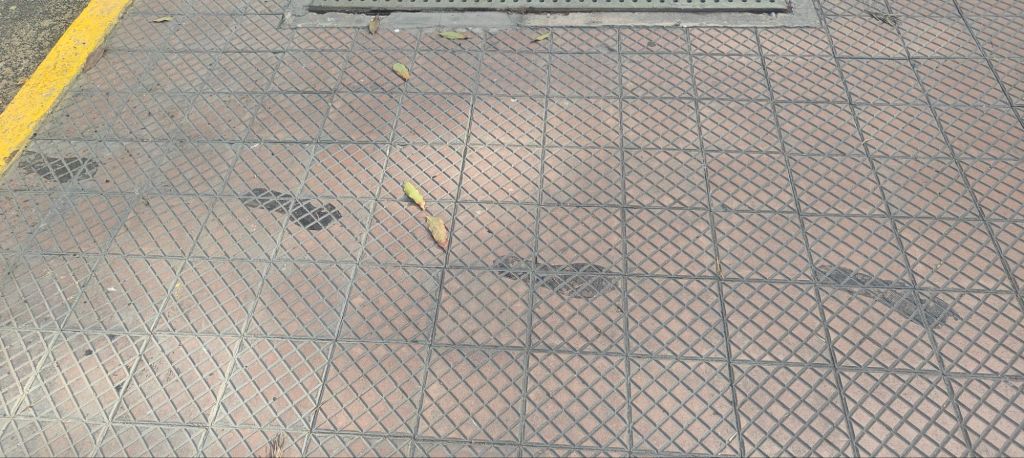
It had been over two years since I’d had the chance to wander its streets. A persistent mist and elderly men with white beards reading alone made up the mostly unexplored canvas of the city for me. Yet upon this visit, it was neither of those things that distracted me, instead, I found my gaze constantly drifting towards the ground below. Footprints pressed into the concrete pavement were frequent, no longer an accident or detail I could breeze past (pardon the pun). I’d never taken notice of this in any other city, a fact made even more noteworthy as I am someone who has a knack for spotting abandoned footwear (another project entirely). Why were there so many footprints dotted about? What did this mean about Lima and the people who lived there?
Perhaps it was because London’s pavements were built from a different type of concrete, was it that simple? Or was it that the English were too polite? A stereotype of course and an outdated one as London is recognised as a global hub, making it a poor explanation. Maybe it was that the people of London were very adherent to the rules and regulations, the literal red tape that would often surround such a freshly paved sidewalk would clearly be enough of a deterrent … right?
Could it be that the Peruvian government invested more in the public infrastructure? Pouring millions of dollars into the concrete sidewalks of Lima with many of the blocks sectioned off at a time and therefore increasing the chances of accidental footprints happening? This also seemed too simple but I admit there is certainly a logic in this hypothetical. Unlike London, Lima was less rainy which gives the Peruvian people more of a chance to lay fresh concrete … although I think I just made that up.
Was it that Peruvian people, more specifically the Peruvians of Lima, were impatient and therefore more likely to cut corners while traversing the city. Is it just part of the city mindset or grindset? Yet London is a very dog-eat-dog place that has less footprint-covered walkways (this statement is obviously anecdotal as surprise, surprise, I have yet to walk every street in London, or Lima for that matter).
Or was it that the people of Lima were more clumsy and less aware of their surroundings? I could see how consistently great food and weather could contribute to a more laissez-faire approach to life. After all, “watch where you’re walking!” is certainly a phrase that can be heard beckoned by an angry Londoner. Even New Yorkers are known for shouting, “Hey! I’m walking here!”. As far as I know there is not a Peruvian equivalent. This isn’t to say one does not exist as I am not exactly a professor of Peruvian linguistics, if that were the case then I’d have a couple of books to my name.
Was it the lack of literal red tape? I’ve been around Peru long enough to realise that when it comes to construction, things are often not done ‘by the book’. Maybe that book got lost in shipping, left on the shelf or simply not read at all (personally I think it is the latter). Unless under the supervision of some mega construction company, many of the health and safety regulations would end up somewhat flouted. With that in mind, would the tape around freshly laid concrete be completely removed from the occasion? Leaving many commuters around the city vulnerable to concrete-covered shoes. Perhaps there is an inside joke about this among Peruvian people that I will later go on to learn. Here’s hoping!
OR was it nothing to do with Peruvian people at all and in fact all to do with the influx of clumsy tourists. Those jetlagged or broken after walking the Inca Trail would be considerably more inclined to make mistakes.
Whatever the reason, the footprints of Lima are many in number and can be seen sprinkled about. From what I can remember they were for the most part a collection of sports shoe imprints, with few high heels scattered about here and there. It is obvious that it was a vast enough occurrence to trigger a sense of enigma in my mind, leading me to write about it.
I will likely never know or meet the people whose outlined feet are pressed into the capital’s street. I do not mind this, at least as far as the near future is concerned. I cannot however promise that it won’t keep me up at night when I hit the age of sixty. Maybe I’ll be fortunate enough to create a documentary about this one day. You could argue that in a way, these prints are a form of abstract graffiti, one more personal than even your signature. This would inadvertently make Lima a city full of truly unsuspecting Graff artists which although cool, doesn’t fit the bill.
I think there is a logical answer to this mystery but for now I think it is better off remaining unanswered.
If you are ever lucky enough to visit Lima, make sure you look down. If you do spot any footprints be sure to take a photo. Send them in if you do, or if you are actually a part of an underground footprint-based cult then also let me know. But if the cult does any weird stuff then please don’t bother … only do it if it is a space for the hip and friendly!
Thanks for reading this slightly odd thought experiment, one that as a half-Peruvian myself has allowed me to explore my other half (wait that sounds wrong).
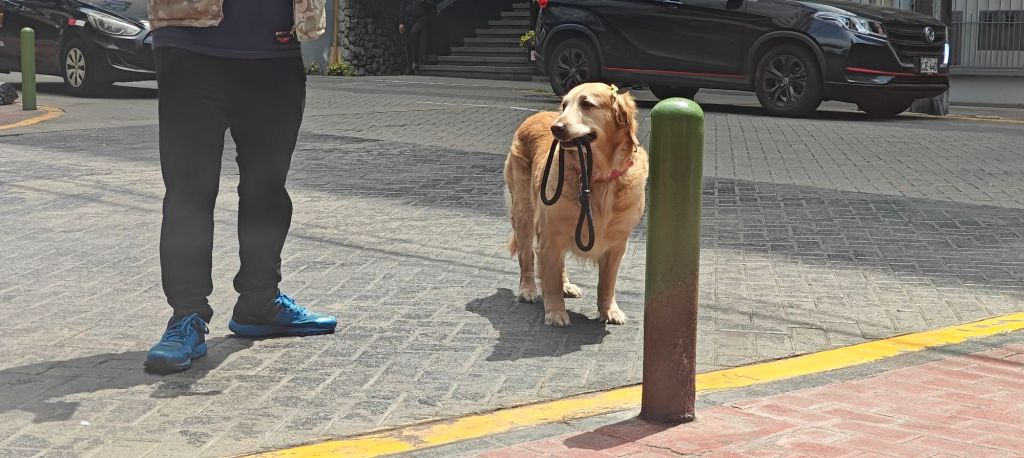
Here’s a cute photo of a dog for making it to the end
While my time away may not have been the ‘Grand Adventure’ I wrote about a few years ago, it gave me a taste of what to wear on foot. Heading to Peru and Brazil for just over six weeks, I took 3 pairs of shoes. These were the La Sportiva TX4, Salomon Speedcross 4 GTX and Nike SB PS8. The first two I had already trialled out in my last trip to Peru ‘22 so I knew how they already passed muster, but the PS8 still had a lot to prove.
The night before the flight out I spent umming and ahhing between taking my recently purchased Nike Lava Domes from ‘03 or my just-as-recently pair of PS8s. Eventually, I went with the Nike PS8 simply because they were less likely to fall apart. The Lava Domes I had sourced from Vinted and being over twenty years since they released had me slightly concerned. Unfortunately this meant putting on hold my dream of capturing a shot of me along the Peruvian mountainside that was inspired by the classic ACG advert of the two climbers descending K2. As they say, there’s always next time …
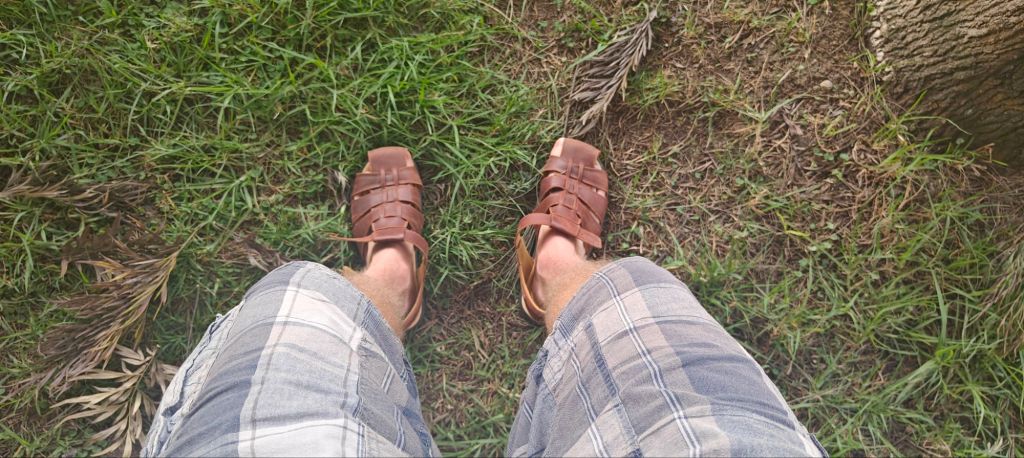
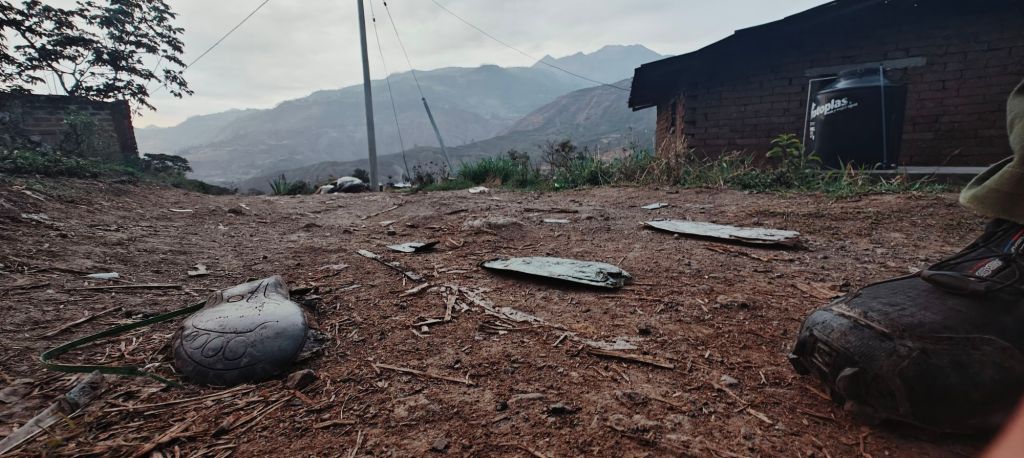
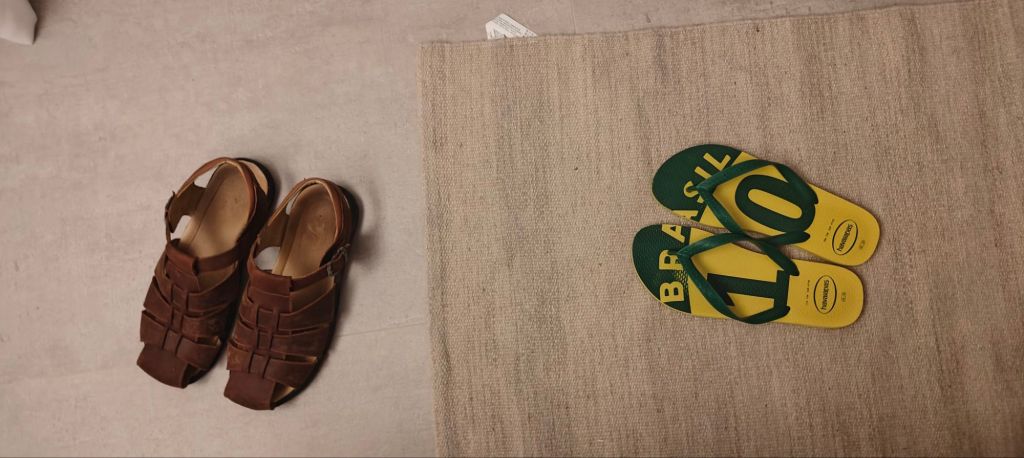
I ended up wearing the Nike SB PS8 until we ascended into the mountainside where I would spend the next three weeks. There I would end up swapping in a pair of Fisherman Sandals I had bought from the Trujillo’s footwear district. These ran me back 120 soles or approximately £20 and had me feeling like a prime Steve McQueen (minus the charm and sex symbol status), a small price to pay considering.
The Fisherman Sandals I wore for the majority of my time in Peru, were similar to our protagonist from Kerouac’s On The Road and how he swore by his pair of Mexican Huaraches. Admittedly, I was clocking in significantly fewer miles on foot, although if we count the number of air miles they tallied up then it could be a close call.
Allowing the tootsies to breathe as well as providing decent protection from any tarantulas crawling about the dark meant the Fisherman Sandals soon became a favourite of mine. Being light enough to carry, I was also able to strap them onto my bag throughout the travels between airports, revealing to me the importance of weight. Romanticising the idea of knocking about in a pair of heavy-duty leather boots during future trips has since become less practical.
Arriving in the northerly beach town of Natal, Brazil would suddenly render my Fisherman Sandals less than ideal. Having a knack for carrying around sand and creating funky tan lines were just two teething points I discovered during my first two days. Not to mention they only helped me stick out like a sore thumb, a fact I tried my best to disguise for multiple reasons. That being said, the Umbro England shorts I wore as swim shorts didn’t aid this disguise.
On day three I’d had enough of my Sandals and wandered into one of the many Havaianas shops along the beachfront. I spotted a pair of football-inspired ones hanging from the racks, a familiar yellow and green beckoning from its spongy sole. At a retail price of 25 Real (approximately £4), they were soon slapping against the bottom of my feet like an old friend (a metaphor which doesn’t really make sense but sounds great).
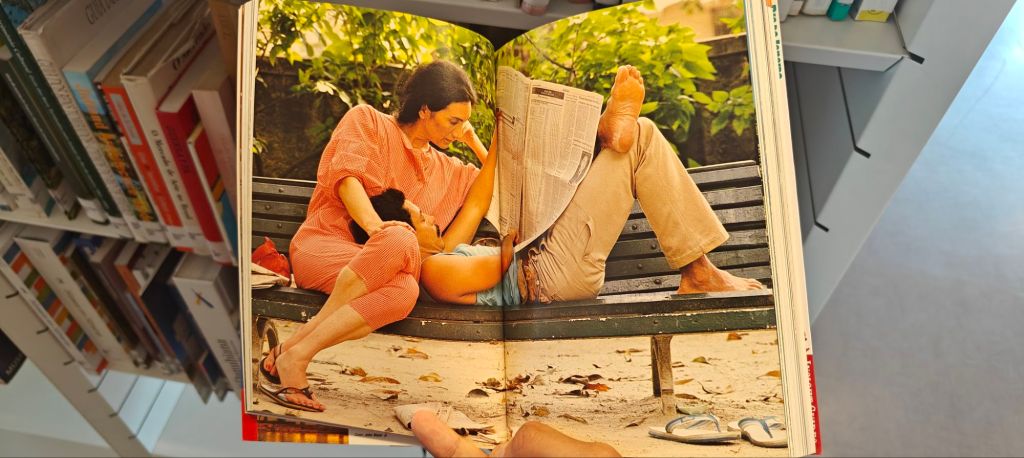
A Haviaianas advert I spotted in the Modern Art Museums Library
A week or so later I was in Rio, a city I had longed to set foot in for the past two years. For this leg of the journey, I had booked an apartment about 800 meters from the beach. Here my daily step count shot up and I would find my Fisherman Sandals coming back into action. Getting about the older parts of the city where the financial district and museums were would also mean blending in to avoid any of the more colourful characters and tourist traps. This was also relatively easy thanks to the Flamengo F.C shirt I picked up from the high street in Ipanema.
Once out in the warmer climates of South America, the need for fully protective footwear was less of a concern. This was partly because I wasn’t exactly hiking up mountains each day, although trips into the Peruvian village for dinner at night did mean having to lace up my Speedcross 4s. The longer I can wear open-toed footwear the better, although when it came to steep descents, these types of shoes inevitably fell short.
One of the many great Vibram sole swaps out there today
This leads me to think that a pair of Keen Sandals could be worth trying next time. Either that or a pair of hybrid Fisherman Sandals that has a lugged Vibram outsole glued on. Perhaps even one of the New Balance Niobium concepts however the most minimal section of the shoe usually relies on a slipper-based silhouette, defeating the whole open-toe objective. While I am not seriously considering taking my Fishermans to the Vibram workshop in London to get them kitted out, you do only live once as the famous saying goes. Plus with all the astroturf hybrids coming into fray, I wonder if a trail-inspired Fisherman Sandal is as radical as it sounds.
It goes without saying that travelling for any significant time abroad does mainly concern the climate. For example, my cousin swears by her Salomon XT-6s which she wore for the entirety of her trip around East Asia. Secondly, ‘fitting in’ or not attracting attention plays another major role in the decision-making process.
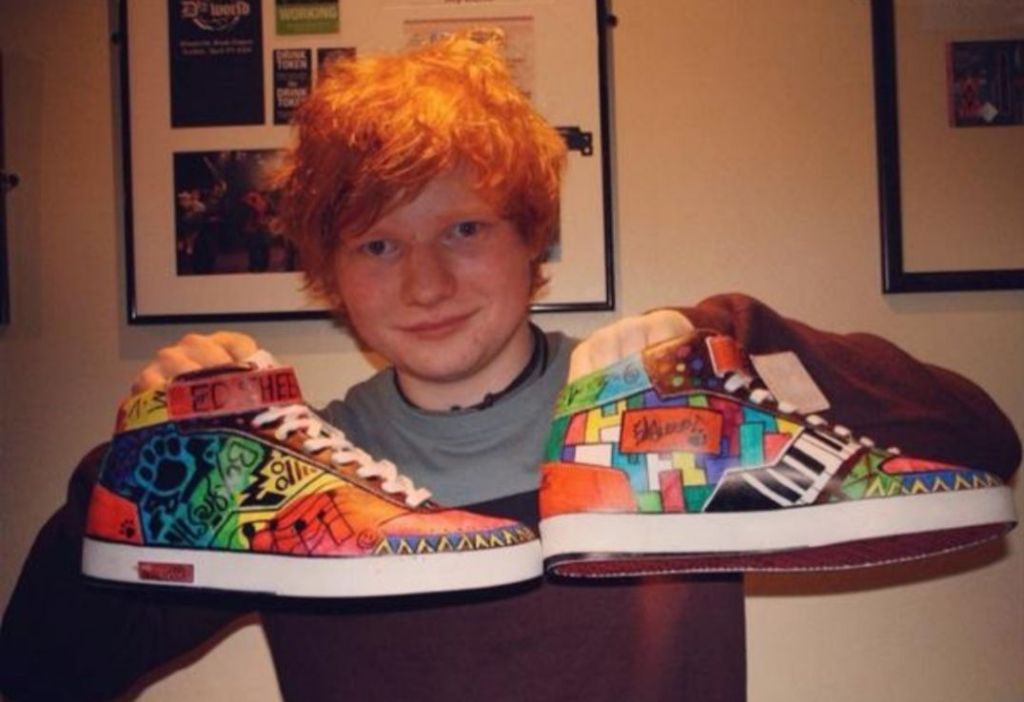
If you can source a locally-used piece of footwear for a reasonable price, then it not only speaks towards your respect towards the culture you are currently emersed in but it can also act as a symbol of the time spent in said space. That said, if you’re rocking around in a pair of Havaianas and you’re Ed Sheeran, the fiery red hair on the top of your head will likely outweigh your snazzy set of flip-flops… so swings and roundabouts really.
Ed Sheeran in 2009 showing off the least inconspicuous pair of high tops imaginable
[On a further note, the idea that global popstar Ed Sheeran can simply ‘blend in’ anywhere on this earth is silly – so no type of footwear will help this matter, just in case he reads the blog].
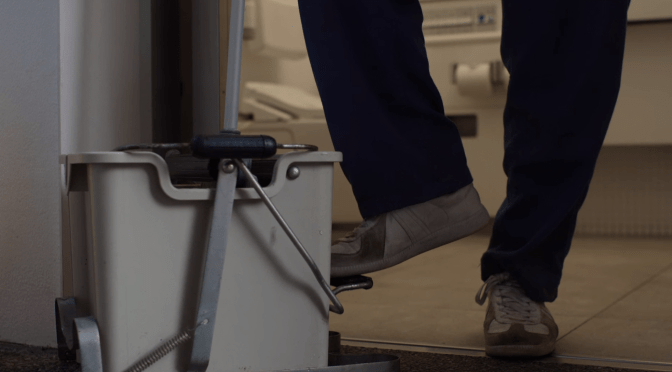
One of my favourite films in the last few years is Wim Wender’s Perfect Days. Upon my first watch, I spotted the main protagonist wearing a pair of GATs (German Army Trainer), the perfect choice for such a character.
Thanks to its sole intended purpose as a military training shoe, the GAT has since been adopted by many fanbases. Whether it’s the Japanese Americana enthusiast, Margiela Replica lovers or just people after practical footwear, the Army Trainer is a classic option for all. Built during the post-plimsole era, the silhouette was an answer to German military personnel looking for a pair that could keep up with the demands of basic training.
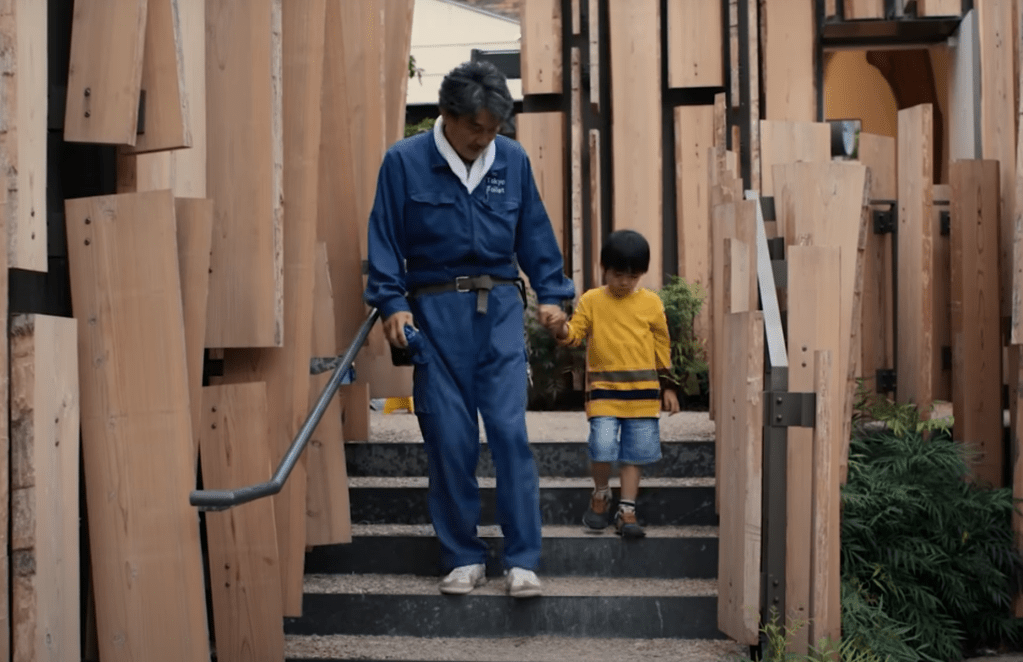
Classic lines, a majority leather construction and hit of suede have made this a staple for many, including our main character Hirayama. Certainly tough enough to withstand the rigorous shifts of a Tokyo city toilet cleaner, this is an excellent example of where the GAT is serving a more functional role. As we witness throughout the runtime, Hirayama is a man of few possessions, with his trusty GATs a key part of his work uniform.
In my mind, this footwear-based choice made on behalf of customer designer Daisuke Iga was spot on. Even the white and grey colourway was the correct choice, revealing how meticulous our protagonist is at keeping his uniform clean, a detail made abundantly clear by the bright shade of white.
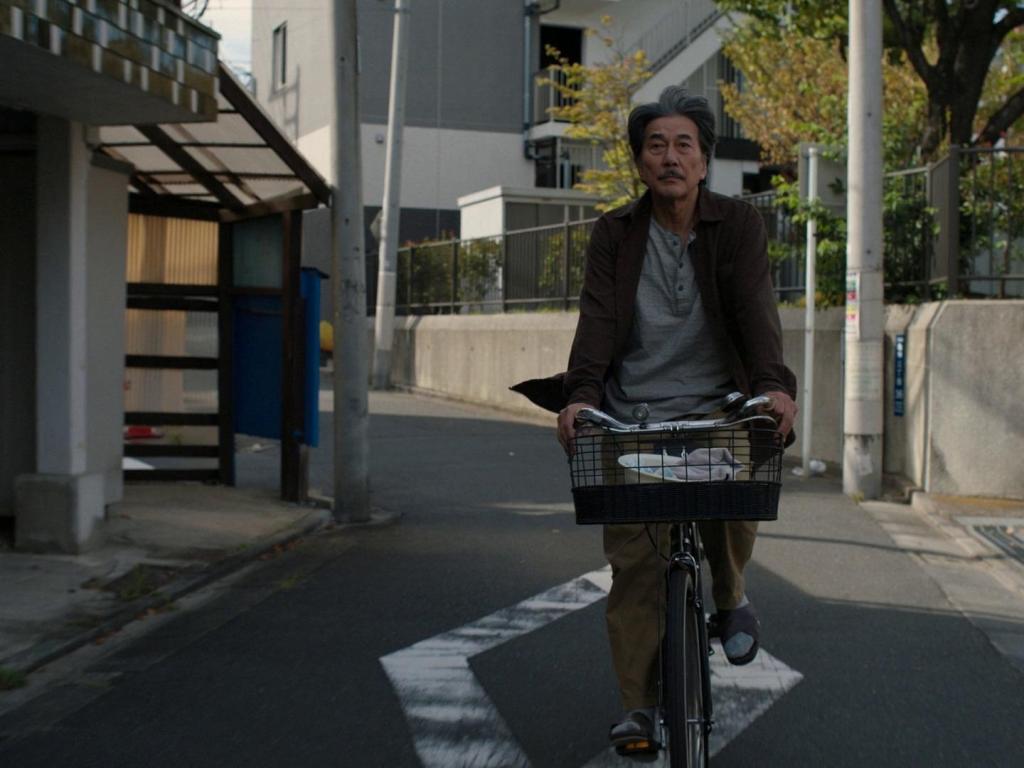
Other scenes such as the cycle ride with niece Nico show Hirayama putting aside his practical footwear and instead opting for a comfy pair of sandals. Another decision made by Daisuke is that of the traditional slides and how they imply a state of change outside the strict and almost military approach Hirayama takes towards his work. We can also see this through the rest of his outfit and demeanour, not to mention the zen mindset he communicates to his niece – “Next time is next time”.
It is only towards the end of the film in which we see a pair of New Balance 996 in a traditional NB Grey being sported. A shoe which was once a pinnacle of running technology upon its first release, the shoe much like our character is reluctant to cry out for attention.
I have repeatedly watched this film since its release and will continue to do so for years to come – particularly because of the excellent costume design by Daisuke. While the film’s message is totally adjacent to the world of sneaker collecting, it emphasises the importance of looking after our possessions, no matter how much we own. This is a message some of us including myself should embrace.
I finally watched Return To Seoul the other day. It will stay with me for a long time. As if this was Ji-Min Park’s debut acting appearance.
Similar to a scene in Paris, Texas by Wim Wenders where the protagonist has a line of shoes sat on a wall after having polished them because of his insomnia.
This scene involves the main character’s (Freddie) father offering to buy her a pair of shoes from the village market from his childhood. There’s a deep connection when buying someone footwear, especially when it comes to your child.
Here, the father takes the opportunity to protect his daughter’s feet, a role he would have enjoyed filling if he had not regrettably given her up for adoption decades ago. His longing for connection is a feeling we encounter throughout the film’s runtime, achieved here in a minor way through this simple act.
Growing up in a catholic school, you would often hear about Jesus washing the feet of his disciples. A symbolic act, this idea was referred to many a time, its meaning something I still have yet to fully appreciate to this day.
The symbolism in this scene can go amiss, it’s only fleeting afterall – yet its moments like this where director Davy Chou has gradually painted a portrait which feels so very real.
If I ever create a book about footwear then best believe this moment will be printed in amongst the pages.
Couldn’t recommend this film more, especially if you’re in your mid 20s.









 wear shoes, write poems